
You are using an out of date browser. It may not display this or other websites correctly.
You should upgrade or use an alternative browser.
You should upgrade or use an alternative browser.
Geena Davis
- Thread starter style_savy
- Start date


YoninahAliza
Active Member
- Joined
- Apr 28, 2010
- Messages
- 3,384
- Reaction score
- 3
WOW. Geena Davis looks stunning in this old issue of Vogue. A total knockout, I especially love the third black & white picture of her. Thanks for sharing justaguy! 
I also wanted to add I absolutely love the work she's doing with The Geena Davis Institute on Gender in Media. It's really wonderful to see someone who's primarily chosen to play dynamic female characters take a stand about the way gender is portrayed in the media and the effects of this. Of course my favorite role of her's has to be Mackenzie Allen from Commander in Chief (though the show was canceled far too soon)!
I also wanted to add I absolutely love the work she's doing with The Geena Davis Institute on Gender in Media. It's really wonderful to see someone who's primarily chosen to play dynamic female characters take a stand about the way gender is portrayed in the media and the effects of this. Of course my favorite role of her's has to be Mackenzie Allen from Commander in Chief (though the show was canceled far too soon)!


VogueGirl8910
Well-Known Member
- Joined
- Apr 14, 2008
- Messages
- 47,957
- Reaction score
- 8,909
Interview March 1992
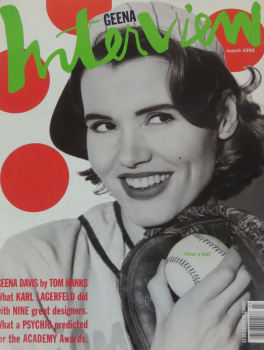
Model/Star: Geena Davis
Photographer: Matthew Rolston
Stylist: Randy Palmer
Hair: Teddy Antolin
Makeup: Carol Shaw
ebay.com/Downtown Books Milwaukee
Model/Star: Geena Davis
Photographer: Matthew Rolston
Stylist: Randy Palmer
Hair: Teddy Antolin
Makeup: Carol Shaw
ebay.com/Downtown Books Milwaukee


Nymphaea
Well-Known Member
- Joined
- Oct 30, 2012
- Messages
- 6,196
- Reaction score
- 695
The Edit The Interview


net-a-porter
Her greatest role left an indelible mark on Hollywood. Now, the actress is aiming to revolutionize global gender inequality.
Photographs by THOMAS WHITESIDE
Styling by TRACY TAYLOR
Geena Davis has blazed a Hollywood trail or two in her time. She’s even had a crack at an Olympic one, taking 24th place in the qualifiers to represent the US in archery, aged 43. But the current path she is attempting to clear is undoubtedly the most important yet.
In 1991, when Davis and Susan Sarandon drove a Ford Thunderbird off a sheer cliff in Thelma & Louise, choosing death rather than jail, audiences of both genders responded to their declaration of female independence with alacrity. Two smart women as the lead roles, knocking even Brad Pitt into a lagging third place, taking the law into their own hands – it was a critical and commercial success, and one in the eye for all those who insisted on casting men as the leads and women merely as their foils. Then, a year later, when Davis starred as baseball player Dottie Hinson in A League of Their Own, its box-office success was met with similar surprise and pleasure.
“[The reaction] was remarkable, so I thought, great, there will be more films involving sport and women,” says 58-year-old Davis over pancakes in Malibu, her striking face contorting with incredulity as she tells the story.
“A League... was such an eye-opening experience; it showed me how few opportunities we get to feel empowered and inspired by female characters. The characters I’m most attracted to are the ones in charge of their own being – they remain in control of what happens to them. That was the thought behind hiring me as Dr. Herman in Grey’s Anatomy; they needed
someone empowering.”
So, when was the next film about female sport released? A decade later – 2002’s Bend it Like Beckham, incidentally also a huge success, making a global star of Keira Knightley. But even away from Hollywood, women playing sport on screen is still a rare sight – the number of hours of competitive female sport currently shown on US television is roughly equal to those given over to fishing. Fishing.
While Davis had always noted the disparity between the number of female roles and the standing of them (how many films have you seen where the primary character is: a) female; b) a CEO of a multinational company; or c) unentangled in a romantic relationship), it wasn’t until she was watching television with her young family that she noticed the entrenched gender inequality in children’s entertainment. In her forties, having met and married her fourth husband, cosmetic surgeon Reza Jarrahy, she gave birth first to a daughter, Alizeh, then twin boys, Kian and Kaiis. Watching TV with them, Davis noticed that one film featured just a solitary female character. And, even more worringly, no one had thought this odd.
Thankfully, Davis has always been one to question the status quo. “None of my friends saw [the disparity],” she says, “so I decided if I had meetings with producers I would casually ask if they noticed how few female roles there were. Every person I asked said, ‘That’s been fixed’, and then mentioned movies of theirs that had just one female character. We’ve been conditioned to see a very skewed ration as normal, so when [film executives] do one strong female role, they think they’re done. So I did research to prove I was right and discovered that the ratio of male to female characters has been exactly the same since 1946.”
In fact, Davis’ research found that for every one female-speaking character in family films, there are three men. And only 3.4 per cent of business leader roles and 4.5 per cent of high-level politicians are portrayed by women. As Davis says, “We are enculturating kids from the beginning to see females as taking up less than half of the space. Couldn’t it be that the percentage of women in leadership roles – politicians, law partners, Fortune 500 board members, professors – stall out at around 17 per cent because that’s the ratio we’ve come to see as the norm?”
In 2007, she set up the Geena Davis Institute on Gender in Media to start putting the word out. As an industry colleague, Davis had no problem getting studio executives to take a meeting and, once in there, they listened. “We presented the research and they were stunned, absolutely aghast to see how few female characters there were. Because they didn’t know,” she says.
We may not be thrilled that women are so easily forgotten when it comes to movies, but at least it makes it easier to do something about it. “On the set of Stuart Little there was a scene with computer games and I saw a producer handing remotes to the boys, leaving the girls standing behind them. So I said, ‘Do you think you could give half the remotes to girls?’ He was horrified he hadn’t thought of it. So it’s just about making people think.”
Davis assures that the response is always receptive, but reading up on the subject, there are some who hold on to the notion that women will watch movies starring men, while men do not return the favor. Davis bristles. “Women buy 51% of [movie theater] tickets and go slightly more then men,” she says. “This idea that women will watch men but men won’t watch women is just not true. I mean, how many examples do we have of movies starring women that are hugely successful? We know that movies starring a woman or directed by a woman are equally financially successful as movies directed by or starring men (once you adapt the budget, because men’s movies tend to have a bigger budget).”
Last month in New York, the actress revealed the Institute’s latest research results, examining female representation within film and TV in Australia, Brazil, China, France, Germany, India, Japan, Russia, South Korea, the US and the UK. A frustrating 78 per cent of workersin the analyzed films were male and just a quarter of the films had a woman as a lead or co-lead driving the plot.
Davis is hopeful, though, that the Institute’s campaign will start to move the dial on those figures. “We have evidence that we have influence in the movies that have been coming out, but we haven’t been able to measure it yet. I have a feeling that within five years we’ll see that it moved significantly enough to mean something.” So what can the rest of us do to help? “Question. Teach others to question,” Davis enthuses. “There is so much that we need to do in every country to raise the status of women, but entertainment is the only place we can do it overnight.” Then let us hope that life can begin to imitate art.
net-a-porter


fashionista-ta
Well-Known Member
- Joined
- Jul 14, 2005
- Messages
- 17,375
- Reaction score
- 921
She looks fantastic ... beautiful skin. And love the work she's doing ... so important.

Not Plain Jane
Well-Known Member
- Joined
- Mar 3, 2010
- Messages
- 15,483
- Reaction score
- 858
^  yes! agree on all counts
yes! agree on all counts
Not Plain Jane
Well-Known Member
- Joined
- Mar 3, 2010
- Messages
- 15,483
- Reaction score
- 858
thelma and louise is 25 years old today.
i seriously cannot get over how great these two women look!
this article talks about the film, feminism, etc.
http://www.harpersbazaar.com/culture/film-tv/a14917/thelma-and-louise-0516/
i seriously cannot get over how great these two women look!
this article talks about the film, feminism, etc.
http://www.harpersbazaar.com/culture/film-tv/a14917/thelma-and-louise-0516/


jexxica
Well-Known Member
- Joined
- Mar 14, 2009
- Messages
- 31,710
- Reaction score
- 372
NEW YORK, NY - OCTOBER 06: Actress Geena Davis speaks at 'The Exorcist' panel during day 1 of 2016 New York Comic Con at Hammerstein Ballroom on October 6, 2016 in New York City. (Photo by Nicholas Hunt/Getty Images)

jexxica
Well-Known Member
- Joined
- Mar 14, 2009
- Messages
- 31,710
- Reaction score
- 372
LOS ANGELES, CA - DECEMBER 07: Geena Davis attends The Hollywood Reporter's Women in Entertainment Breakfast at Milk Studios on December 7, 2016 in Los Angeles, California. (Photo by David Crotty/Patrick McMullan via Getty Images)

HighMaintenance
Active Member
- Joined
- Jul 9, 2008
- Messages
- 7,027
- Reaction score
- 9
Geena Davis is seen at the Sundance Festival on January 22, 2017


zimbio
zimbio
Similar Threads
- Replies
- 14
- Views
- 5K

- Replies
- 10
- Views
- 2K


Users who are viewing this thread
Total: 1 (members: 0, guests: 1)
