Chanel Pre-Fall 2026 New York | Page 19 | the Fashion Spot

Chanel Pre-Fall 2026 New York

Their prices are not accessible though. And the new clothes don't look luxurious or flattering. So what do they offer to bring people to spend $8k on a basic jacket?
The chainlink is never visible. It is always inside a jacket.
I think that this new direction has sent traditional customers away to other brands. The question is can they find enough new customers to offset. If you own the Karl rtw you will be appalled by the quality after LN started. This is the real "if you know, you know."
Hmm…
Maybe let’s talk with a bit more nuance.
From the talks I had with my S.A. is that for the most part the general sentiment is curiosity (in all the Parisian stores so far and internationally).
They saw the reaction of social media but they can’t really make nothing out of it because it doesn’t really have an impact considering that the collection hasn’t hit the floor and that the pre-orders are good. And while some clients, generally tourist are showing some concerns they seems positive.

She also reminded me that the brand’s collections in recent years weren’t met always favoribly but there was a resilience in the clientele and also a large offer in stores.

She also said to me that for all the people who slightly went away from the brand during the Virginie era, there were clients still coming for classic tweed suits and things that were more professional friendly.

Also about something that is suspected about Couture, they expanded during Virginie’s by opening the archives for reproduction, which is something Karl wasn’t necessarily fan of.

And she said to me finally that Matthieu seems to be very interested in what is going one « over here » (in stores).

So really I don’t believe the « Chanel clients are going to fly to another brand in mass ».
I have never found another replacement for Chanel. I have never went elsewhere to buy a « Chanel version » of something. But they have the opportunity to expand in reality. A lot of women can find themselves buying Chanel despite having the money and never been interested before.

I must say that I was confused by the little Christmas accessories collection in introduction. I saw some people buying it. It’s fine but I don’t understand why they didn’t sent those bags to celebrities or editors.

It’s there in stores, they tells you it’s a teaser but they don’t know if it will be permanent or not lol.

But they will figure it out. They have a lot of clients events, even more, for 2026.
 
I think they didn't necessarily go to another big luxury brand to replace chanel. Probably went for mid-tier lesser known brands that offers the same craftmanship as the old chanel until Chanel gets it together.

Id like to think Chanel rtw clients are very loyal
From what I’ve seen, they don’t actually abandon the brand they just buy less. And “less” is still something like $200k a year instead of $350k. Even when they complain about quality, it rarely turns into a boycotting of the brand. It becomes more selective buying: fewer pieces, more scrutiny.

What keeps them tethered isn’t just the RTW itself, but the relationships, access, and brand perks that come with being a top client. At that level, purchases aren’t purely about liking the clothes, ego, status, and continuity play a huge role. Chanel is part of how they see themselves

@jeremydante Thank you for sharing that. I have to respectfully disagree.

Making Chanel feel welcoming, (I don’t think it was unwelcoming before, possibly unapproachable), isn’t inherently bad, but for me luxury isn’t just about being less obvious or more everyday. Fora fashion house, it’s an about a point of view strong enough to withstand dilution. When the clothes start to feel like “clothes first, Chanel second, that’s decentering the very language that made Chanel Chanel. I will give him some more time though
 
@Lola701
My point is similar to the above @reese06 "something like 200k a year instead of 350k" though I do know one girl who is in boycott mode. She is well taken care of by another top tier brand so she doesn't care.
I don't purchase Chanel bags and I rarely buy their costume jewelry so my view doesn't matter.
the relationships, access, and brand perks that come with being a top client. At that level, purchases aren’t purely about liking the clothes, ego, status, and continuity play a huge role. Chanel is part of how they see themselves
Yes there is a group of them for sure.
Ultimately as I said before, it will become a quantitative discussion when the revenue numbers come out. When you have hundreds of vics who downsize their Chanel spending by 43%, it will need more new customers to offset.
 
@Lola701
My point is similar to the above @reese06 "something like 200k a year instead of 350k" though I do know one girl who is in boycott mode. She is well taken care of by another top tier brand so she doesn't care.
I don't purchase Chanel bags and I rarely buy their costume jewelry so my view doesn't matter.

Yes there is a group of them for sure.
Ultimately as I said before, it will become a quantitative discussion when the revenue numbers come out. When you have hundreds of vics who downsize their Chanel spending by 43%, it will need more new customers to offset.
It matters. Your POV matter.
A lot of people are having opinions on things they don’t purchase so don’t shy away from expressing yours.

The thing about Chanel and a lot of brands in this climate is that, the trend in slight decrease in the luxury fashion market will be a good enough justification if there’s another slip in sales.
A lot of brands will give themselves 1/2 to adapt their retail strategy.

I don’t believe in a miracle trend. People from the industry I know don’t either.

But they S.A. are ready to work. The response was apparently even more positive for the Metiers d’Arts apparently but as always, clients wants key items. The experience in stores is usually more nuanced.
 
One lady I know ordered fewer pieces - not deposit paid but a wish list. She is not committed to them. She was just curious and wanted to try.

Big number. Is there a rigorous study behind it?

The SS06 collection actually had very few logo pieces (Chanel on the Charvet shirt is poor decision making though). My guess is that the suits had him add those for Metiers. Chanel added lots of logo-centric customers under VV's later years, so they need to keep them.
Big number. Is there a rigorous study behind it?
yes me like facts :) i need to find the article again i read it this morning but its from Bain luxury data the research

But more outlets wrote about it like this Vogue one below and BOF below has also something on the 2 % VIC

VOGUE BUSINESS
After two years of sluggish demand, the luxury market will return to growth in 2026, up between 3% and 5%, according to the latest report from management consultancy Bain, in partnership with Italian luxury goods association Altagamma.

The organizations expect 2025 spending to close broadly flat at €1.44 trillion (between -1% and 1% growth). The personal luxury goods market is expected to reach €358 billion by the end of the year, compared to €364 billion last year and €369 billion in 2023 — a 2% year-on-year decline at current exchange rates, and flat at constant rates.

It’s a promising light at the end of the tunnel after a prolonged slump for luxury. In 2024, the market contracted for the first time (excluding Covid) since the great recession. The market shrunk by 2%, and luxury lost 50 million customers in the process. In June, Bain said the outlook for 2025 was clouded by tariffs and had outlined three possible scenarios for performance. Now, Bain is forecasting the best scenario, with better-than-expected performance in the US more than compensating for softer-than-expected results in Europe. Bain confirmed that over the next 10 years, the personal luxury goods market is likely to grow between 4% and 6% per year, reaching between €525 billion and €625 billion, while overall luxury spending could span €2.2 trillion to €2.7 trillion.

“It’s good news that, given the global uncertainties — turmoil, tariffs, geopolitical instability, wars, the macroeconomic environment and consumer confidence — this market is stable. This is a positive message, because it seems that customers have an appetite for luxury,” says Federica Levato, partner at Bain, who co-authored the report.

By market, the Middle East and rest of world category performed the best, up between 4% and 6% this year driven by tourist flows and local demand. The Americas remained relatively stable, with volatility in the first half but recovery in the second, thanks to the stock market recovery and confidence among high-earning consumers. Europe suffered due to a lack of tourists, as did Japan; Mainland China is still down, but has started showing some signs of stabilization as of Q3. As a whole, this amounted to a more stable global luxury market.

Despite the improvements, brands are still failing to provide sufficient value. Luxury’s new customer acquisition has declined 5% in the past year, and the market is currently serving less than half — between 40% and 45% — of its addressable consumers (in 2022, the figure was around 60%). “The gap is widening, and this is a worrying message for the market,” says Levato. “Even the very wealthy customers are feeling betrayed by the continued elevation, so they are directing their spending to other categories — travel, experiences, or value-for-money brands.”


BOF

How Luxury Brands Aim to Keep the 2% Coming Back for More​

Exclusive labels are lavishing top-spending clients with special events as luxury’s customer base shrinks.
Mytheresa took clients to Turin

Mytheresa held a client event in Turin. (Lucas Possiede)

18 December 2025
BoF PROFESSIONAL

Key insights​

  • Retaining top-spending clients is paramount for high-end brands as they navigate a two-year slump.
  • “It is no longer just about owning beautiful objects; it is about the memories we create around them,” said Boucheron chief executive Hélène Poulit-Duquesne.
  • From opera-house dinners in Turin to mosaic-making lessons in Rome, luxury houses are becoming more creative with personalized events to deepen loyalty.

Aqila Agha has been buying large quantities of Gucci products for 30 years, first dressing her daughters, now 17 and 21, in the storied Italian fashion label when they were infants. She sometimes purchases an entire Gucci collection and has a personal stylist at the brand’s corner in Harrods.

“My husband always says there are three people in this marriage – him, me and Gucci,” said Agha, who lives in London. “He’s not wrong, but if I’m happy, he’s happy.”

Keeping top spenders like Agha happy and coming back for more is critical for Gucci and its luxury rivals as they navigate a two-year slump. Inflation and economic uncertainty have weighed on appetite from aspirational shoppers, with the industry losing 60 million customers since 2022, according to estimates from consultancy Bain. Clients across the spectrum are questioning the value proposition of luxury goods amid soaring prices, tariffs and reports of worker exploitation in supply chains.

In this choppy environment, luxury houses are drawing on experiences as a key tool in their brand arsenal, pulling out all the stops with unusual and creative events to keep their wealthiest clients engaged.

“You need to do more than just the usual flagship store opening VIP parties with champagne and canapés where you see the new collection,” said Citi analyst Thomas Chauvet, noting it is becoming more expensive to recruit and retain top customers.

In October, Gucci offered Agha the opportunity to purchase a red coat – a style seen on Demi Moore in the film “The Tiger” and one of the first pieces designed by Demna for Gucci – well before it becomes more widely available in January. She has been a guest of Gucci at fashion shows in Paris and Milan, including once with her daughters.

A red Gucci coat that featured in the film The Tiger worn by Demi Moore
Aqila Agha's Gucci coat, the style Demi Moore wore in the film “The Tiger.” (Aqila Agha)
Analysts estimate VICs, usually defined as the top 2-4 percent of spenders, account for as much as 40 percent of luxury goods sales. For some companies, it’s even higher – at Mytheresa, 4 percent of customers generate almost half of annual revenue.

For the past decade, Mytheresa has created distinct experiences for clients, often in collaboration with the client’s brand of choice. The German luxury e-tailer recently took top clients to Venice for lunch, followed by a factory tour in nearby Vicenza, to see knitwear being made for Alaïa. The founder of the factory, who was a friend of the house’s founder, Azzedine Alaïa, was on hand for the tour; a dinner with the chief executives of Mytheresa and Alaïa followed.

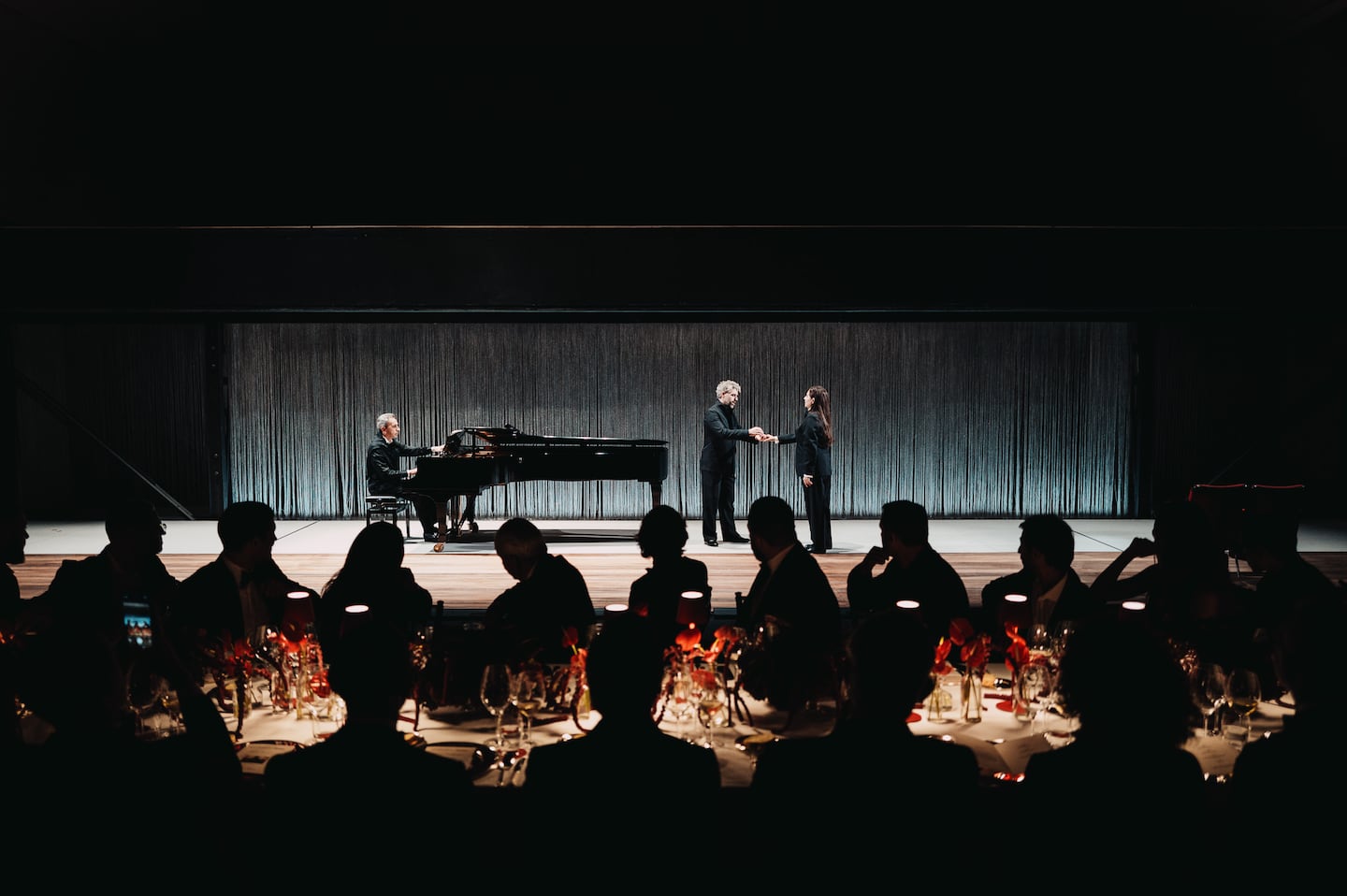
Mytheresa has also held a series of Dolce & Gabbana-themed multi-day events in Taormina this year, taking clients to the Four Seasons hotel featured in season 2 of “The White Lotus.” In October, it teamed up with Zegna, inviting a small group of guests to dine on the stage of Turin’s sprawling opera house, with a private performance of four sopranos singing arias from “La Bohème” and “La Traviata.”

“We are always thinking about how we can engage with customers in a very bespoke way,” said Amber Pepper, Mytheresa’s chief marketing and customer service officer. “These opportunities enhance loyalty. They really bring the emotional connection between the customer and us. They bring them into our community.”

Companies do not disclose how much revenue they generate with VICs (Agha also declined to disclose any figures), but some analysts estimate it exceeds $100,000 per year in some cases, though often spread among several brands.

Asked about the profitability of such client events, Mytheresa declined to provide financial details, but said they were key for building loyalty.


“Absolutely they work or we wouldn’t be doing them,” said Mytheresa’s Pepper. “We have a lot of data [showing efficacy]. If you do it in the right way, these events can create very, very strong loyalty with customers.”

Moncler has also partnered with Mytheresa to launch new lines, taking clients last year to Oslo and this month to Gstaad, in the Swiss Alps. Armani has held several-day events in Venice where clients dined in the Doge’s Palace and on the island of Capri.

Boucheron recently hosted a dinner in New York City’s Central Park and an event at the French embassy in Bangkok that included a runway show to present the label’s jewellery.

Boucheron dinner in Central Park
French jewellery house Boucheron held an intimate dinner in New York City's Central Park. (Patricia Burmicky for Central Park Conservancy)
“I strongly believe the future of luxury is experiential and emotional,” said Boucheron CEO Hélène Poulit-Duquesne. “It is no longer just about owning beautiful objects; it is about the memories we create around them. Offering these ‘money-can’t-buy’ moments allows us to build a genuine, intimate connection with our clients.”

Guests at Maria Grazia Chiuri’s last runway show for Dior, held in Rome in May, were invited on a special tour of the city organised by If Experience, a local events company.

Rome-based If Experience also recently set up private events for Bulgari Hotels that included a mosaic-making lesson in the loggia of the 13th Century House of the Knights of Rhodes overlooking the Roman Forum. They also offered an intimate jewellery-making session with Bulgari creative director Lucia Silvestri.

“An experience for 50 or 60 people is no longer good enough,” said Filippo Cosmelli, an art historian and creative director of If Experience. “It used to be brands wanted to organise a dinner for 300 people. Now, they want something for two people.”

Agha, who was a Gucci VIC long before lavish experiences became more prevalent, said the brand’s efforts are keeping her engaged. Gucci has taken her on trips to Florence and other cities, immersing her in brand history. At a dinner, she was seated across the table from Francois-Henri Pinault, chairman of Gucci-owner Kering, and met his wife, the actress Salma Hayek, at another event.


Aqila Agha is a Gucci client
Aqila Agha attends a Gucci dinner. ((Aqila Agha))
“I can 100 percent say from my own experience – and I shop with different brands – that Gucci really look after their clients,” said Agha. “The Italians are in a league of their own in terms of hospitality, being part of the family and it feels genuine.”

But she was quick to point out that her loyalty isn’t guaranteed from collection to collection. Surprised by the choice of Demna as creative director for Gucci, Agha said she’s still not sure he’ll be the right fit.


She liked Demna’s take on the archives, ahead of his own vision for Gucci to come at the next Milan fashion week, noting Tom Ford and Alessandro Michele were two of her favorite previous designers at the brand.

“I want to see the first collection that’s really Demna’s before deciding,” Agha said.

 
To me the worst thing of all this is to see how mediocre people praise this kind of offerings and elevate them to something they are not.

I feel there’s a fight to make JW and MB the new Karl Lagerfeld and the new Galliano, yet they are not even 1/100000.

Fashion is run by mediocre people now. Influencers are not even mediocre, they are social garbage. New journalists are either low IQ or have simply no morals nor ethics and sell their souls for a show ticket :lol: and that’s why we get these designers, because they represent the society we live in.
the truth but nothing but the truth .....the truth hurts" because it often shatters comforting illusions, contradicts desires, challenges self-esteem, and forces confrontation with unpleasant realities about ourselves or the world, causing immediate pain, even though facing it is essential for growth.
aka Hater in 2025 lol
 
Small question: Where though?

My small feedback, to take with a grain of salt, not based on a survey amongst 1000 women but of actually talking to three Chanel ex-customers:

-one left for Valentino, because the quality and aftercare service at Chanel (for the bags) wasn't as expected and she told me Valentino is far superior in that regard

-two left for Miu Miu, because prices at Chanel went out of control, and Miu Miu offers the girly-modern-cool vibe at less expensive prices.

I am not stating that Miu Miu or Valentino are taking the spot of Chanel. Not at all.
But customers looking for other options because of 1.quality and 2.prices, it is a reality.

In my ideal world, the Chanel costumer as I imagine her would move to Haider's Tom Ford, like tricotineacetat said.
 
prices at Chanel went out of control,
ill never understand this, prices everywhere are out of control. not only Chanel. They all wanna reach Chanel prices so bad so why settle for a lesser brand just to save a little. i doubt the difference between chanel and others now are crazy big, unless they moved to nicholas' LV which is very understandable. Id like to be in the circle too, and out of my dusty chanel friends
 
ill never understand this, prices everywhere are out of control. not only Chanel. They all wanna reach Chanel prices so bad so why settle for a lesser brand just to save a little. i doubt the difference between chanel and others now are crazy big, unless they moved to nicholas' LV which is very understandable. Id like to be in the circle too, and out of my dusty chanel friends
I don't know why people do what they do, but believe me, they do it 🤣
 
My small feedback, to take with a grain of salt, not based on a survey amongst 1000 women but of actually talking to three Chanel ex-customers:

-one left for Valentino, because the quality and aftercare service at Chanel (for the bags) wasn't as expected and she told me Valentino is far superior in that regard

-two left for Miu Miu, because prices at Chanel went out of control, and Miu Miu offers the girly-modern-cool vibe at less expensive prices.

I am not stating that Miu Miu or Valentino are taking the spot of Chanel. Not at all.
But customers looking for other options because of 1.quality and 2.prices, it is a reality.

In my ideal world, the Chanel costumer as I imagine her would move to Haider's Tom Ford, like tricotineacetat said.
One of those days I might enter their store :P
 
ill never understand this, prices everywhere are out of control. not only Chanel. They all wanna reach Chanel prices so bad so why settle for a lesser brand just to save a little. i doubt the difference between chanel and others now are crazy big, unless they moved to nicholas' LV which is very understandable. Id like to be in the circle too, and out of my dusty chanel friends
To me, no seam allowance on jackets will be a deal breaker.
 
Big number. Is there a rigorous study behind it?
yes me like facts :) i need to find the article again i read it this morning but its from Bain luxury data the research

But more outlets wrote about it like this Vogue one below and BOF below has also something on the 2 % VIC

VOGUE BUSINESS
After two years of sluggish demand, the luxury market will return to growth in 2026, up between 3% and 5%, according to the latest report from management consultancy Bain, in partnership with Italian luxury goods association Altagamma.

The organizations expect 2025 spending to close broadly flat at €1.44 trillion (between -1% and 1% growth). The personal luxury goods market is expected to reach €358 billion by the end of the year, compared to €364 billion last year and €369 billion in 2023 — a 2% year-on-year decline at current exchange rates, and flat at constant rates.

It’s a promising light at the end of the tunnel after a prolonged slump for luxury. In 2024, the market contracted for the first time (excluding Covid) since the great recession. The market shrunk by 2%, and luxury lost 50 million customers in the process. In June, Bain said the outlook for 2025 was clouded by tariffs and had outlined three possible scenarios for performance. Now, Bain is forecasting the best scenario, with better-than-expected performance in the US more than compensating for softer-than-expected results in Europe. Bain confirmed that over the next 10 years, the personal luxury goods market is likely to grow between 4% and 6% per year, reaching between €525 billion and €625 billion, while overall luxury spending could span €2.2 trillion to €2.7 trillion.

“It’s good news that, given the global uncertainties — turmoil, tariffs, geopolitical instability, wars, the macroeconomic environment and consumer confidence — this market is stable. This is a positive message, because it seems that customers have an appetite for luxury,” says Federica Levato, partner at Bain, who co-authored the report.

By market, the Middle East and rest of world category performed the best, up between 4% and 6% this year driven by tourist flows and local demand. The Americas remained relatively stable, with volatility in the first half but recovery in the second, thanks to the stock market recovery and confidence among high-earning consumers. Europe suffered due to a lack of tourists, as did Japan; Mainland China is still down, but has started showing some signs of stabilization as of Q3. As a whole, this amounted to a more stable global luxury market.

Despite the improvements, brands are still failing to provide sufficient value. Luxury’s new customer acquisition has declined 5% in the past year, and the market is currently serving less than half — between 40% and 45% — of its addressable consumers (in 2022, the figure was around 60%). “The gap is widening, and this is a worrying message for the market,” says Levato. “Even the very wealthy customers are feeling betrayed by the continued elevation, so they are directing their spending to other categories — travel, experiences, or value-for-money brands.”


BOF

How Luxury Brands Aim to Keep the 2% Coming Back for More​

Exclusive labels are lavishing top-spending clients with special events as luxury’s customer base shrinks.
Mytheresa took clients to Turin

Mytheresa held a client event in Turin. (Lucas Possiede)

18 December 2025
BoF PROFESSIONAL

Key insights​

  • Retaining top-spending clients is paramount for high-end brands as they navigate a two-year slump.
  • “It is no longer just about owning beautiful objects; it is about the memories we create around them,” said Boucheron chief executive Hélène Poulit-Duquesne.
  • From opera-house dinners in Turin to mosaic-making lessons in Rome, luxury houses are becoming more creative with personalized events to deepen loyalty.

Aqila Agha has been buying large quantities of Gucci products for 30 years, first dressing her daughters, now 17 and 21, in the storied Italian fashion label when they were infants. She sometimes purchases an entire Gucci collection and has a personal stylist at the brand’s corner in Harrods.

“My husband always says there are three people in this marriage – him, me and Gucci,” said Agha, who lives in London. “He’s not wrong, but if I’m happy, he’s happy.”

Keeping top spenders like Agha happy and coming back for more is critical for Gucci and its luxury rivals as they navigate a two-year slump. Inflation and economic uncertainty have weighed on appetite from aspirational shoppers, with the industry losing 60 million customers since 2022, according to estimates from consultancy Bain. Clients across the spectrum are questioning the value proposition of luxury goods amid soaring prices, tariffs and reports of worker exploitation in supply chains.

In this choppy environment, luxury houses are drawing on experiences as a key tool in their brand arsenal, pulling out all the stops with unusual and creative events to keep their wealthiest clients engaged.

“You need to do more than just the usual flagship store opening VIP parties with champagne and canapés where you see the new collection,” said Citi analyst Thomas Chauvet, noting it is becoming more expensive to recruit and retain top customers.

In October, Gucci offered Agha the opportunity to purchase a red coat – a style seen on Demi Moore in the film “The Tiger” and one of the first pieces designed by Demna for Gucci – well before it becomes more widely available in January. She has been a guest of Gucci at fashion shows in Paris and Milan, including once with her daughters.

A red Gucci coat that featured in the film The Tiger worn by Demi Moore
Aqila Agha's Gucci coat, the style Demi Moore wore in the film “The Tiger.” (Aqila Agha)
Analysts estimate VICs, usually defined as the top 2-4 percent of spenders, account for as much as 40 percent of luxury goods sales. For some companies, it’s even higher – at Mytheresa, 4 percent of customers generate almost half of annual revenue.

For the past decade, Mytheresa has created distinct experiences for clients, often in collaboration with the client’s brand of choice. The German luxury e-tailer recently took top clients to Venice for lunch, followed by a factory tour in nearby Vicenza, to see knitwear being made for Alaïa. The founder of the factory, who was a friend of the house’s founder, Azzedine Alaïa, was on hand for the tour; a dinner with the chief executives of Mytheresa and Alaïa followed.

Mytheresa has also held a series of Dolce & Gabbana-themed multi-day events in Taormina this year, taking clients to the Four Seasons hotel featured in season 2 of “The White Lotus.” In October, it teamed up with Zegna, inviting a small group of guests to dine on the stage of Turin’s sprawling opera house, with a private performance of four sopranos singing arias from “La Bohème” and “La Traviata.”

“We are always thinking about how we can engage with customers in a very bespoke way,” said Amber Pepper, Mytheresa’s chief marketing and customer service officer. “These opportunities enhance loyalty. They really bring the emotional connection between the customer and us. They bring them into our community.”

Companies do not disclose how much revenue they generate with VICs (Agha also declined to disclose any figures), but some analysts estimate it exceeds $100,000 per year in some cases, though often spread among several brands.

Asked about the profitability of such client events, Mytheresa declined to provide financial details, but said they were key for building loyalty.


“Absolutely they work or we wouldn’t be doing them,” said Mytheresa’s Pepper. “We have a lot of data [showing efficacy]. If you do it in the right way, these events can create very, very strong loyalty with customers.”

Moncler has also partnered with Mytheresa to launch new lines, taking clients last year to Oslo and this month to Gstaad, in the Swiss Alps. Armani has held several-day events in Venice where clients dined in the Doge’s Palace and on the island of Capri.

Boucheron recently hosted a dinner in New York City’s Central Park and an event at the French embassy in Bangkok that included a runway show to present the label’s jewellery.

Boucheron dinner in Central Park
French jewellery house Boucheron held an intimate dinner in New York City's Central Park. (Patricia Burmicky for Central Park Conservancy)
“I strongly believe the future of luxury is experiential and emotional,” said Boucheron CEO Hélène Poulit-Duquesne. “It is no longer just about owning beautiful objects; it is about the memories we create around them. Offering these ‘money-can’t-buy’ moments allows us to build a genuine, intimate connection with our clients.”

Guests at Maria Grazia Chiuri’s last runway show for Dior, held in Rome in May, were invited on a special tour of the city organised by If Experience, a local events company.

Rome-based If Experience also recently set up private events for Bulgari Hotels that included a mosaic-making lesson in the loggia of the 13th Century House of the Knights of Rhodes overlooking the Roman Forum. They also offered an intimate jewellery-making session with Bulgari creative director Lucia Silvestri.

“An experience for 50 or 60 people is no longer good enough,” said Filippo Cosmelli, an art historian and creative director of If Experience. “It used to be brands wanted to organise a dinner for 300 people. Now, they want something for two people.”

Agha, who was a Gucci VIC long before lavish experiences became more prevalent, said the brand’s efforts are keeping her engaged. Gucci has taken her on trips to Florence and other cities, immersing her in brand history. At a dinner, she was seated across the table from Francois-Henri Pinault, chairman of Gucci-owner Kering, and met his wife, the actress Salma Hayek, at another event.


Aqila Agha is a Gucci client
Aqila Agha attends a Gucci dinner. ((Aqila Agha))
“I can 100 percent say from my own experience – and I shop with different brands – that Gucci really look after their clients,” said Agha. “The Italians are in a league of their own in terms of hospitality, being part of the family and it feels genuine.”

But she was quick to point out that her loyalty isn’t guaranteed from collection to collection. Surprised by the choice of Demna as creative director for Gucci, Agha said she’s still not sure he’ll be the right fit.

She liked Demna’s take on the archives, ahead of his own vision for Gucci to come at the next Milan fashion week, noting Tom Ford and Alessandro Michele were two of her favorite previous designers at the brand.

“I want to see the first collection that’s really Demna’s before deciding,” Agha said.
I don´t get the "brand experience" concept. Basically this feels like brands "bribing" their customers, so they feel obliged to buy their products (even if they don´t feel really interested on them). I think the product should be desiderable on its own, without having to do anything to get rich customers wanting to buy them. But as their products are crap, they have to resort to this kind of manipulative tactics.

“It is no longer just about owning beautiful objects; it is about the memories we create around them. Offering these ‘money-can’t-buy’ moments allows us to build a genuine, intimate connection with our clients.”

Money is literally buying those moments!! As if they were to invite a guy who purchased a 100ml eau de toilette from them... :rofl:
 
I don´t get the "brand experience" concept. Basically this feels like brands "bribing" their customers, so they feel obliged to buy their products (even if they don´t feel really interested on them). I think the product should be desiderable on its own, without having to do anything to get rich customers wanting to buy them. But as their products are crap, they have to resort to this kind of manipulative tactics.

“It is no longer just about owning beautiful objects; it is about the memories we create around them. Offering these ‘money-can’t-buy’ moments allows us to build a genuine, intimate connection with our clients.”

Money is literally buying those moments!! As if they were to invite a guy who purchased a 100ml eau de toilette from them... :rofl:
lets not forget when you can buy everything people get bored so they look for brand extensions that are part of their lives and also surprise and entertain them.

its the extioned of hermes offering you something to drink when you sit down to ask for things your looking for ...you know its free but also paid by the profits they make still it feels nice to be offered on a hot summer day.

people paying a premium know and expect that brands profits are paying for stores and locations and ads and these experiences and the free champaign and trips.
its a gesture its banking on human connection in the end deals are about making a connection to make money if both sides feel they win its not manipulative ..it's when on side feels robbed you get a uneven relationship.

best way to explain is creating more special shopping occasions with early access or only top clients products etc and also arranging special access to things as a thank you from the brand like visit to x wine villa that normally is closed off or meet and great with F1 driver during race seasons etc etc
can be anniversaries or birthdays or knowing their wishes etc.

all luxury brands do this from airlines to hotels groups to credit card high spenders to private banks car makers watchmakers etc.
 
lets not forget when you can buy everything people get bored so they look for brand extensions that are part of their lives and also surprise and entertain them.

its the extioned of hermes offering you something to drink when you sit down to ask for things your looking for ...you know its free but also paid by the profits they make still it feels nice to be offered on a hot summer day.

people paying a premium know and expect that brands profits are paying for stores and locations and ads and these experiences and the free champaign and trips.
its a gesture its banking on human connection in the end deals are about making a connection to make money if both sides feel they win its not manipulative ..it's when on side feels robbed you get a uneven relationship.

best way to explain is creating more special shopping occasions with early access or only top clients products etc and also arranging special access to things as a thank you from the brand like visit to x wine villa that normally is closed off or meet and great with F1 driver during race seasons etc etc
can be anniversaries or birthdays or knowing their wishes etc.

all luxury brands do this from airlines to hotels groups to credit card high spenders to private banks car makers watchmakers etc.
The problem is that nowadays the "human connection" is more interesting than the crap they are trying to sell through it.
 
Last edited:
The problem is that nowadays the "human connection" is more interesting than the crap they are trying to sell through it.
Why many clients opt out of invites after a while you know whats interesting or worth your time to not attend 10045 brand events.
also spend one or 2 season less and poof ur of the list:)
 
Why many clients opt out of invites after a while you know whats interesting or worth your time to not attend 10045 brand events.
also spend one or 2 season less and poof ur of the list:)
I find the whole "brand experience" concept very cringey...like an expensive Tupperware party. Feels desperate!
 
I find the whole "brand experience" concept very cringey...like an expensive Tupperware party. Feels desperate!
many are its often a pissing contest between clients as well at the event i dont go to any anymore , also brand staff is like interviewing you on your life its not luxury to me it's often i come back to the hotel room thinking its all tacky no matter how much expense has been made.
I seen both sides i think there is a lack of detail and innovation in clientservice to much is on optics.

few brands get it right few staff get it right or make things personal in a organic discreet way ...but many clients like to be treated like sun kings in any situation as well so there is a market for it in sense of i dont see it get less.
 
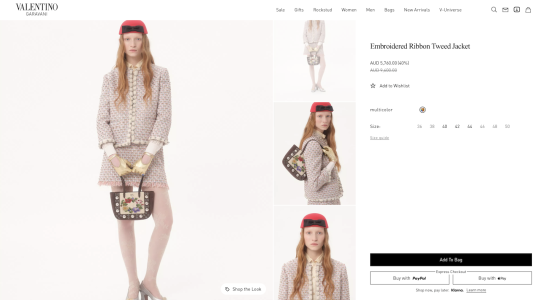
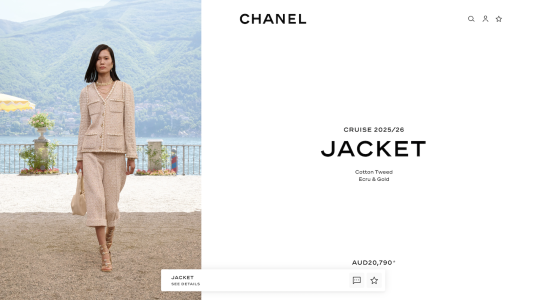
i doubt the difference between chanel and others now are crazy big, unless they moved to nicholas' LV which is very understandable.

Valentino tweed jacket (with embroidery) vs. Chanel tweed jacket
9600AUD (Original Price) vs 20,790AUD
Both made in Italy, both using similar craftsmanship (I wouldn't be surprised if it were at the same factory) except the Valentino one has added embroidery.

Screenshot 2025-12-21 at 1.59.49 PM.png
Screenshot 2025-12-21 at 1.59.22 PM.png
VALENTINO & CHANEL
 

Users who are viewing this thread

New Posts

Forum Statistics

Threads
216,524
Messages
15,342,367
Members
90,207
Latest member
randorando
Back
Top