Chanel Pre-Fall 2026 New York | Page 8 | the Fashion Spot

Chanel Pre-Fall 2026 New York

I still haven’t sorted out the strategy behind the brand’s rollout of the show online, however. Rather than streaming live, the brand staged two shows for clients and press hours before releasing the official video on its website — creating a vacuum that allowed amateur photography to drive the narrative.
To be fair, the first and only time a Chanel show was streamed live, this happened:
CCSS26.jpg
CHANEL.COM
 
Chanel under Karl was elegant but fun, Cara's look isn't that bad because she can carry that outfit. It's painful there's no that kind of Chanel muse anymore (I'm surprised Mona didn't open the show). Glad to see some familiar faces like Natasha, Karmen or Hanne Gaby. This look very Virginie post covid era. Her first year kept part of Karl's spirit, but then 2020 started with this current nightmare. Give me 1000 Vogue covers with these, lol.
 
But Chanel has been always quite random. I’ve never thought Karl has that distinctive directions or vision. Yeah there always been clothes that like tweed jacket or skirt. But do you guys think he really has that distinctive directions? I mean image wise, his campaigns have been random all the time. It’s little bit surprised how people perceive history of this brand?

He was very versatile and flexible but his collection’s themselves were typically still coherent in my opinion. Glance at Chanel Spring 1995 RTW or Spring Couture 2010, there’s a clearl visual thoroughline in all the designs, which communicates an artistic message and a fashion direction. Its’s easy (even reflexive) to associate each look with one another. This goes for plenty other runway presentations regardless of anyone’s personal affections too- Miu Miu Fall 1997, Armani Spring 2009, Gucci Spring 2010, even something as high energy as McQueen SS04. It’s not a high bar for me, it’s kinda a basic expectation. Whether color palette, elements, structure, style, cut, etc, something should connect the individual looks to one another. For me this show fails at that. At leastttt 20 patterns are each used only once(and it legit might be more if I actually counted) , every color of the rainbow is present, and the silhouettes, outerwear, shoes, bags, etc often have nothing in common from look to look. It’s a visual cacophony.

But yes, Karl had some hideous looks and even bad shows, Spring 2015 Couture for instance(but I don’t really think the issue there was a lack of unity to the designs, the direction itself was simply wack). Regardless it doesn’t really change my opinion of this show as lacking in focus or direction though. It’s not algebra, there’s no need to balance some imaginary equation. And for the record, I have no emotional attachment to KL. I don’t want him back, I want MB to get better.
 
i liked this way more than his debut, and i do think chanel needed this kind of fresh air, that part i get.. personally, it's his taste/eye that i just can't connect with.. even though there were pieces that i genuinely liked.
now the fact that he didn't want the collection to feel linear, that's exactly where i think he missed the mark. it doesn't come across as fun or fresh, it just feels messy; summed up with that aesthetic of his (heavily associated with bottega now) it ends up overpowering chanel instead of elevating it.
i'm not totally unhappy with him, but definitely not convinced either.
 

Chanel Holds a Starry Fashion Show in the New York City Subway​

by Vanessa Friedman
It’s not often that you run into ASAP Rocky on a New York City subway platform. Or the society doyenne Deeda Blair for that matter. It’s not often that you see Kristen Stewart posing on the stairs running deep underground, or Bowen Yang, Jon Bon Jovi and Solange pushing their way through a turnstile.
But then again, it’s not often that Chanel brings a show to New York.

The last time was 2018, when Karl Lagerfeld, then the grand lord pooh-bah of the brand, brought the Métiers d’Art show (the line created in conjunction with the specialist ateliers Chanel bought to preserve their know-how) to the Temple of Dendur at the Metropolitan Museum of Art, offering up another kind of monument in gold and haute Egyptian kitsch.

This time, Matthieu Blazy, the current Chanel artistic director, flipped the script. Sure, the procession of guests jamming the entrance to the abandoned train station on Bowery and Kenmare Street showing off their Chanel everything — their bouclé coats and shoes and earmuffs, their quilted bags and boots and portfolio cases — was as absurd a juxtaposition in its own way as the earlier double C ode to the pharaohs of today.

But as a statement of difference between now and then, it doesn’t get much more dramatic.

Not long after the Temple of Dendur show, Mr. Lagerfeld died. Stewardship of Chanel passed to his longtime deputy, Virginie Viard, who doggedly hewed to his template, steering the brand through the coronavirus pandemic and global expansion with loyalty, if not inspiration. Mr. Blazy was hired a year ago to bring back the sizzle and sense of adventure.

Boy, did he. If Mr. Blazy’s debut show, held in October in the Grand Palais in Paris amid a set created to resemble the universe, was an introduction to the world of Chanel as he saw it, this Métiers d’Art show brought it all down to earth in an exhilarating mishmash of clothes, moods and mentalities. For every outfit, there was a personality.

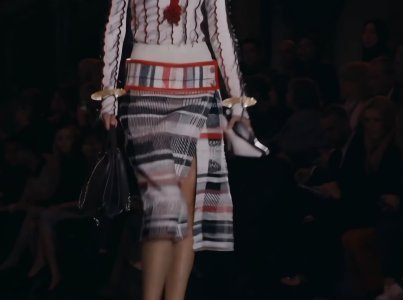
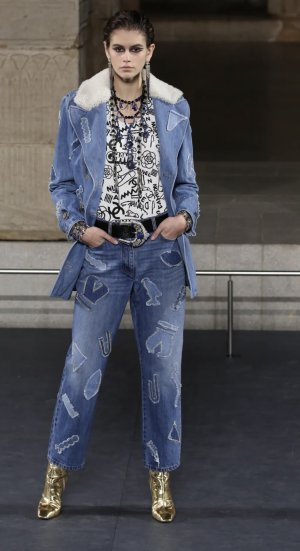
There were familiar tweedy Chanel suits woven to resemble leopard print for ladies who lunch not on salad but on spreadsheets. There were busker jeans that turned out not to be jeans at all but faded silk trousers with frayed patches made of glistening beads, and flannels that weren’t flannels but trompe l’oeil bouclé.


The model Hanne Gaby Odiele wore a sequined red sheath under a giant black feathered chubby, hair in a giant chignon, and she tapped her heels as she stared impatiently down the tunnel as if late for the opera. Alex Consani, in double-breasted pinstripes, lounged against a pillar as though waiting to make a deal. Long, feathery tops were tied over slouchy trousers and T-shirts. One tweedy suit came with a Superman shirt underneath. Another came with a coffee cup hanging off a handbag chain.

There were little black dresses with raised waistlines and ’60s poufs at the knee, and long black dresses with a flapper feel. Indeed, there were more evening dresses than there had been in Mr. Blazy’s first collection. (Just in time for awards season.) Odds are the devoré sequined number and a silver-spangled Art Deco style will be coming soon to a red carpet near you.

“It’s something that I did not explore a lot in the first show,” Mr. Blazy admitted in an interview after his subway had finally left the station. “I’m trying to build up and introduce new codes.” To that end, there was not an obvious double C, camellia or pearl in sight, though everything was still obviously Chanel. In two shows, Mr. Blazy has liberated the brand from the clichés of its past, the better to move forward.

Pointing to a flannel overshirt, for example, Mr. Blazy called it “a new classic.” Chanel had her famous jacket, he noted. Maybe this could be his.

As it happens, the decision to hold his second show in New York was both personal and strategic. Chanel has a long history in the United States, which is its largest market for ready-to-wear, according to Bruno Pavlovsky, the head of fashion. Coco herself came through New York in 1931 during a trip that also took her to Hollywood, and she found inspiration on its streets. So did Mr. Blazy, who lived in the city earlier in his career when he worked at Calvin Klein. That experience, he said, made him love the subway in part because it has “no hierarchy.”

“Every strata of society is still using it, from the student to the musician to the game-changer,” Mr. Blazy said. “I wanted to create the kind of happy chaos that we see every morning when we go to work and you don’t know what’s going to be at the corner.” It could be, he said, a mother on the run. It could be someone dressed up as Spider-Man.

That’s an awfully romantic (some might say out of touch or even tone deaf) way to think about what for many is a painful part of the daily routine and a symbol of New York’s decline. But for a few hours on Tuesday, Mr. Blazy actually made mass transit seem like the most gorgeous way to go.

The New York Times
 

Blazy Trips in the Subway​

By Cathy Horyn
Since 2002, Chanel has put on a ready-to-wear show called Métiers d’Art. It’s meant to showcase the exquisite work of its satellite ateliers, among them the embroiderers Lesage and Montex, the milliner Maison Michel, and Lemarié, a maker of feather and flower trimmings. Karl Lagerfeld held the first Métiers show in the house’s couture salon, at the top of the famous staircase with guests seated informally about. Soon after, he took the show on the road. On Tuesday, Matthieu Blazy, Chanel’s new creative director, staged two shows on a Bowery subway platform for 1,100 people.

Blazy, who had an outstanding debut in October, had several things in mind. He said he was thinking about Gabrielle Chanel’s first trip to New York in 1931, when she stopped on her way to Hollywood to design clothes for the movie mogul Samuel Goldwyn. Though sick with the flu, she apparently went downtown and was struck by how many women had adapted her style. “I thought, All right, we have a story,” Blazy recalled. “We have energy, the idea of people in the street. And also the idea of Gabrielle touching the cinema. Why don’t we go into the Metro” — that is, the subway — “with archetypal figures that we know are not real, but we see them from a cinema angle.” The college student in her flannel shirt or quarter-zip fleece. The Brooklyn girl. The corporate leader in her suit. The female dandy in pinstripes. The rich widows in chic black. The New Yorkers who literally wear costumes, like Spider-Man.

Blazy envisioned them getting off a subway train as their paths intersected, coffee cups or a purse-size dog in hand. He lived in New York for about two years when he worked for Calvin Klein, and he remembers going into the subway at Times Square and seeing people dressed in evening clothes, perhaps heading to the ballet or opera. “I think in Paris the fashion is more blended,” he said. “There’s more uniformity; whereas in New York you have more types.” Dressed in a quarter-zip himself with roomy trousers, Blazy paused. “I don’t want to sell anyone short, but the differences exist.”

He was also interested in the sense of time, expressed in both the hours of the day — the morning commute, for example — and the temporal associations of clothes, often between the work of two designers from different eras. He brought up the late Stephen Sprouse, whose influence is evident in a knitted suit in a zany yellow-red-black squiggle pattern. He noted that Chanel was doing cotton separates very early on; so were American sportswear designers, and he pointed to a pair of full, airy skirts in checked cotton with contrasting floaty tops. Blazy, who also worked at Martin Margiela’s label, said of Chanel, “When you separate the clothes, they all function. Martin was a master at that too. You see the looks from the early ’90s, they seem extreme. But when you decompose the silhouettes …” He smiled. “I think Martin and Gabrielle were very similar.” A lot of costume historians would agree.

To help evoke a sense of time during the show, Blazy played an audio clip from The Hours, the movie based on Michael Cunningham’s novel of the same title, which, like its inspiration, Mrs. Dalloway, takes place in a single day. “About Time” was also the theme of the 2020–21 costume show at the Met, to which Cunningham contributed material.

Did Blazy’s subway show work? The answer is no. The problem wasn’t that the setting was unglamorous, though it was, or even that showing luxury clothes there might verge on insensitive. Blazy and the Chanel team made it convincingly clear that they were treating the disused Bowery station as a set. The problem was the expression wasn’t artistic. We were essentially an audience looking at 81 models, or characters, as they crisscrossed a platform. Was there really a strong idea here? As a show, it failed, in my view, to lift off and leave you with a sense of wonder or joy — as Blazy’s October show did.

Let’s consider that debut show. He and the Chanel production team filled the ceiling of the Grand Palais in Paris with huge, illuminated spheres, like planets. They implied a world and that Chanel is a global brand. It was an abstract idea. That’s what Blazy needed to do with the Métiers show. Forget the real subway; it’s too mundane. Instead, it would have been far more effective and surprising if the audience had been sitting in a large empty space and, through the use of choreography and sound and lighting effects, we understood that we were meant to be on a chaotic platform for all the hours of a day. Our imaginations could do the work. Indeed, think of Marc Jacobs’s great show in February 2020, his collaboration with the dancer Karole Armitage, when the models evoked the energy of New York — without a set — and actually flowed into the audience, making us part of the action.

That level of artistry — starting from an abstract concept — would naturally have followed, if not surpassed, the buoyant effect of October.

Blazy’s new collection itself was superb: a continuation of many of his ideas about Chanel, beginning with shelving much of the branding details and patterns that had been turning the style into costume. Whether you can afford Chanel or not, this collection presented many sensibilities — the woman who wants to wear a slim belted coat (the tan suede one in the show was based on the much-photographed couch in Chanel’s apartment) over a simple silk blouse and slacks in a matching tone, or the woman who wants the drama of a plush black coat in Lemarié’s feathers over a siren-red sequined slip dress. It’s the outfit the model Hanne Gaby Odiele, in the role of a society matron with a Mars Attacks! French twist hairdo, wore as she looked down the tracks for her train.

The designer showed a lot of curiosity for interpreting some of Chanel’s looks and fabrics from the late 1920s and ’30s, notably leopard patterns and astrakhan (Lesage achieved the same ridged texture and silkiness with embroidery). He got away from the banal grid patterns of tweed bouclés by creating uneven, horizontal weaves and offered lighter cotton tweeds. And he thoughtfully worked in American references. Among the images on a mood board set up in his temporary space at Spring Studios were those of Andy Warhol’s wig, photo shoots on subways, a scene from the artist Carrie Mae Weems’s Kitchen Table Series, and the oil heiress Millicent Rogers, who adored Indigenous American jewelry. I noticed that a chain necklace seemed to have a touch of turquoise. It looked fresh.

What I really love about Blazy’s Chanel is that he keeps breaking assumptions about what Chanel — and luxury — is supposed to be. He showed his version of a red checked “flannel” overshirt worn with a skirt that looks like denim (but isn’t) and a pair of T-strap heels. A dark quarter-zip top paired with a silver embroidered Deco skirt. Khakis were done in silk, though they still retain the drape of chinos. He showed something of the same casual ease with a long sleeveless evening dress, inspired by an early Chanel frock, that he split into a kind of vest, layering it over a white T-shirt and jeans. The result had a vintage flavor but also made me think of Margiela and Miuccia Prada and, of course, Gabrielle.

I asked Blazy about some online comments, perhaps from clients and influencers, complaining that his clothes don’t look recognizably Chanel. They seem to want what they already know about Chanel, rather than what’s new and possible. “I don’t know,” Blazy began. “I don’t want to sound like — I mean, everyone has a voice. Fashion became part of pop culture. I saw the critics who said, ‘It’s not Chanel.’ Well, I think they know Karl. They might have an idea about Coco. But they certainly aren’t aware Gabrielle Chanel was so revolutionary.”

We spoke for a moment about a look in the debut collection, a plain dark jersey polo sweater with a matching silk wrap skirt edged in dirty white. It’s almost nothing, and it isn’t.

He said, “I heard many on the team say, ‘Yes, but it’s so pre-collection.’” You sometimes wonder if the industry knows how to be truly radical. “Of course, I want a strong message on the runway,” Blazy added. “But the opposite works too.”

The thing is, Blazy is just at the beginning of this story, and already he has opened people’s minds. He shows his first haute couture collection in mid-January.

“You may well do a very graphic, stripped-back Chanel collection at some point,” I said. “You’ve got time.”

“And maybe we will,” he said.
The Cut
 
So, I'm not the only one. I suggested a set replica, but suggesting an abstract setup with lighting, sound effects and choreography like Marc Jacobs FW20 really hits the nail on the head. Funny enough, that show was also held in the Park Avenue Amory.
Let’s consider that debut show. He and the Chanel production team filled the ceiling of the Grand Palais in Paris with huge, illuminated spheres, like planets. They implied a world and that Chanel is a global brand. It was an abstract idea. That’s what Blazy needed to do with the Métiers show. Forget the real subway; it’s too mundane. Instead, it would have been far more effective and surprising if the audience had been sitting in a large empty space and, through the use of choreography and sound and lighting effects, we understood that we were meant to be on a chaotic platform for all the hours of a day. Our imaginations could do the work. Indeed, think of Marc Jacobs’s great show in February 2020, his collaboration with the dancer Karole Armitage, when the models evoked the energy of New York — without a set — and actually flowed into the audience, making us part of the action.
THE CUT
 
To that end, there was not an obvious double C, camellia or pearl in sight, though everything was still obviously Chanel.

Gurl what? Did we watch the same show or is she delusional because literally look number had pearl earrings, a pearl necklace, the double CC on the bag, on the pullover, on the denim, and on the belt. Literally not one item in this look was left unbranded. What a gaslighter!

And oh lord help us all if the flannel shirt becomes “a new classic” at Chanel. Literally the most basic and 90s adjacent garment there ever was. And why is he dragging it from Calvin Klein to Bottega and now to Chanel?! Yawn…
 
At the same time, there were looks like this in the Metiers d’Arts from Dallas
IMG_6838.jpeg
Or like this from the last NYC collection
IMG_6839.jpeg

Ok we could argue that the simplicity of the opening look from Blazy can be deceiving but at the same time, the concept in those cases and many more, is to désembourgeoiser the idea of Metiers d’Arts and to apply the same level of quality that we could find on a very precious dress.
The best denim with buttons from Desrues or Gossens, Cashmere/Wool sweater by Barrie, shoes by Massaro.

Maybe where the ultimate Chanel customer would have went to Celine or Saint Laurent for this, Chanel got them covered.

That idea of elevating the ordinary is also very Karl and in some ways very Chanel.
But Chanel has been always quite random. I’ve never thought Karl has that distinctive directions or vision. Yeah there always been clothes that like tweed jacket or skirt. But do you guys think he really has that distinctive directions? I mean image wise, his campaigns have been random all the time. It’s little bit surprised how people perceive history of this brand?

He had a very distinctive vision. It’s just that his vision evolved in 30 years.
But overall it started from a simple point: how to make Chanel relevant in the 80s. At that time, it wasn’t a thing to take over a house and make it work. And he looked at the way the women in the street and his studio dressed. You can’t dissociate Chanel of the 80s/90s with Ines and Victoire. You can’t dissociate Chanel from the late 90 with Amanda and the early 00s to mid 10s from Laetitia and all the girls.
He had a very distinctive aesthetic language but it was really about fashion. So to apply modernity on it just becomes a game.
I remember watching a documentary where a French journalist said that Karl was lucky because even if the beginning were rocky, the Chanel client was eager to play the game with him.

Karl build his language for Chanel out of things she has done but he infused a lot of himself too. He had a very distinctive way of doing eveningwear or dresses for example.
He even narrowed the color palette at Chanel.
I associate Chanel yes with black and white and red and gold. But then his last decade he decided to only do pastel colors. Soft pink, soft blue, soft yellow a bit of navy, a bit of silver.

It’s funny that you mention the campaigns because they were very specific actually. Look at Chanel campaigns before he took over. Look at how he framed his campaigns. The amount of blank space or background in his campaigns.

His Campaigns for Fendi or his own brand were very different in mood and even lighting.

The SS2007 campaign with Freja is terribly Graphic whereas the SS2007 Fendi campaign with Raquel has a total different mood and even if those two campaigns are very similar you can’t mistake which one is Chanel and which one is Fendi.

The thing about Karl is that we got used to his Chanel. Most of us in the world only knew about his Chanel, we take it for granted. And a lot of people aren’t familiar with Karl’s work. A lot of people only knows his Chanel, barely knows his Fendi, his KL and are totally oblivious to whatever he did at Chloe.

A perfect vision comes to fruition with time. It builds and builds and at some point people believe it always existed.
 
Should a collection only be evaluated in its totality? Yes, first its vision, then details, then what you would buy or wish to wear.
In that order its high fashion, the vision comes first than commerce and then reality.


If not its high street or contemporary , garments product merch goods .

It's the rules of anything at the highest standard.

Even Chanel and Prada CEO say the same thing , when people talk about price it means your not presenting them with a story to believe in (a vision)

That's the artistic/art part in High fashion, for that you need a distinctive voice , something to say asking or providing possible solution for progress of your art form and there for mankind.

You speak about garments i speak about point of view , its like you talk about paintings or sculptures as stuff while i talk about the artist.

I am not nostalgic for KL nor VV and people that love blazy at Chanel should stop circle jerk as saying its better than Karl there for its good instead of say this is good period.

when something is only better when its compared to the past one (the worst) does not do a great job to legitimise that its good on its own.

i dont see that the past is fictional in this case because its well documented.
Karl was pop and he did not hide it , your not saying anything new in regard to who he was or seen.
This just feels like an inadequate approach. If you're beginning with something amorphous like "vision," and then proceeding to the details, you're missing the fact that a collection *is* an arrangement of details. When I'm looking at one I'm trying to see both—the micro and the macro. But I'm also trying to figure out which details (i.e. garments) will become representative of the collection overall, because that's *also* how high fashion works. Different looks and pieces will make their way into magazines, onto red carpets, into permanent collections, etc, and in those contexts there's a sort of synecdoche at play. A museum like the MET Costume Institute buys pieces to stand-in for whole collections, or even periods, of a designer's work. Tthat's because looking back, we do remember specific garments and connect them to whole collections.

And the idea that one could talk about an artist (or designer) without talking about the *stuff*—the literal material content of aesthetic production—is absurd. Of course I am talking about them as stuff, because that's what art and fashion are. There's no "vision" or "artist" floating above in the realm of ideas. You have to work through layers of elements, whether that means garments or paintings, or even hemlines or brushstrokes. The point of view is *in* the details, it *is* the stuff. You're not going to understand any sort of cultural work or text if you can't look at it closely. Why would fashion be any different?
 

Users who are viewing this thread

New Posts

Forum Statistics

Threads
215,449
Messages
15,303,057
Members
89,453
Latest member
moxysquib
Back
Top