It’s not often that you run into ASAP Rocky on a New York City subway platform. Or the society doyenne Deeda Blair for that matter. It’s not often that you see Kristen Stewart posing on the stairs running deep underground, or Bowen Yang, Jon Bon Jovi and Solange pushing their way through a turnstile.
But then again, it’s not often that Chanel brings a show to New York.
The last time was 2018, when Karl Lagerfeld, then the grand lord pooh-bah of the brand, brought the
Métiers d’Art show (the line created in conjunction with the specialist ateliers Chanel bought to preserve their know-how) to the Temple of Dendur at the Metropolitan Museum of Art, offering up another kind of monument in gold and haute Egyptian kitsch.
This time, Matthieu Blazy, the current Chanel artistic director, flipped the script. Sure, the procession of guests jamming the entrance to the abandoned train station on Bowery and Kenmare Street showing off their Chanel everything — their bouclé coats and shoes and earmuffs, their quilted bags and boots and portfolio cases — was as absurd a juxtaposition in its own way as the earlier double C ode to the pharaohs of today.
But as a statement of difference between now and then, it doesn’t get much more dramatic.
Not long after the Temple of Dendur show,
Mr. Lagerfeld died. Stewardship of Chanel passed to his longtime deputy, Virginie Viard, who doggedly hewed to his template, steering the brand through the coronavirus pandemic and global expansion with loyalty, if not inspiration. Mr. Blazy was hired a year ago to bring back the sizzle and sense of adventure.
Boy, did he. If Mr. Blazy’s
debut show, held in October in the Grand Palais in Paris amid a set created to resemble the universe, was an introduction to the world of Chanel as he saw it, this Métiers d’Art show brought it all down to earth in an exhilarating mishmash of clothes, moods and mentalities. For every outfit, there was a personality.
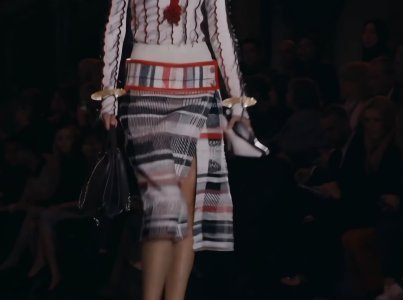
There were familiar tweedy Chanel suits woven to resemble leopard print for ladies who lunch not on salad but on spreadsheets. There were busker jeans that turned out not to be jeans at all but faded silk trousers with frayed patches made of glistening beads, and flannels that weren’t flannels but trompe l’oeil bouclé.
The model Hanne Gaby Odiele wore a sequined red sheath under a giant black feathered chubby, hair in a giant chignon, and she tapped her heels as she stared impatiently down the tunnel as if late for the opera. Alex Consani, in double-breasted pinstripes, lounged against a pillar as though waiting to make a deal. Long, feathery tops were tied over slouchy trousers and T-shirts. One tweedy suit came with a Superman shirt underneath. Another came with a coffee cup hanging off a handbag chain.
There were little black dresses with raised waistlines and ’60s poufs at the knee, and long black dresses with a flapper feel. Indeed, there were more evening dresses than there had been in Mr. Blazy’s first collection. (Just in time for awards season.) Odds are the devoré sequined number and a silver-spangled Art Deco style will be coming soon to a red carpet near you.
“It’s something that I did not explore a lot in the first show,” Mr. Blazy admitted in an interview after his subway had finally left the station. “I’m trying to build up and introduce new codes.” To that end, there was not an obvious double C, camellia or pearl in sight, though everything was still obviously Chanel. In two shows, Mr. Blazy has liberated the brand from the clichés of its past, the better to move forward.
Pointing to a flannel overshirt, for example, Mr. Blazy called it “a new classic.” Chanel had her famous jacket, he noted. Maybe this could be his.
As it happens, the decision to hold his second show in New York was both personal and strategic. Chanel has a long history in the United States, which is its largest market for ready-to-wear, according to Bruno Pavlovsky, the head of fashion. Coco herself came through New York in 1931 during a trip that also took her to Hollywood, and she found inspiration on its streets. So did Mr. Blazy, who lived in the city earlier in his career when he worked at Calvin Klein. That experience, he said, made him love the subway in part because it has “no hierarchy.”
“Every strata of society is still using it, from the student to the musician to the game-changer,” Mr. Blazy said. “I wanted to create the kind of happy chaos that we see every morning when we go to work and you don’t know what’s going to be at the corner.” It could be, he said, a mother on the run. It could be someone dressed up as Spider-Man.
That’s an awfully romantic (some might say out of touch or even tone deaf) way to think about what for many is a painful part of the daily routine and a symbol of New York’s decline. But for a few hours on Tuesday, Mr. Blazy actually made mass transit seem like the most gorgeous way to go.