L'étiquette Magazine (Spring 2026) - Interview w/ Dries Van Noten
Published March 26, 2026
Text formatted for readability
L'étiquette Magazine (Spring 2026) - Interview w/ Dries Van Noten
Published March 26, 2026
We went to designer Dries Van Noten with one question. He replied with a fashion story.
You don't really need a special reason to want to talk to the great Dries Van Noten, do you? But that day, we did want to ask him something in particular, and it felt almost existential. Why has Belgium been such a dominant force in fashion for decades? How on earth can a country of 11 million people and only around 12,000 square miles produce so many great designers, one after the other? Today, Chanel is helmed by a Belgian, as are Versace, Prada, Saint Laurent and Diesel. How can such a tsunami of talent be explained? Dries Van Noten certainly has an opinion on the matter.
The Antwerp native belongs to the pioneering generation of Belgian fashion designers known as the Antwerp Six. Having trained at the Royal Academy of Fine Arts alongside Ann Demeulemeester, Walter Van Beirendonck, Dirk Bikkembergs, Dirk Van Saene and Marina Yee, he was part of this disparate group with opposing styles but united by a strong sense of solidarity and friendship. As the Antwerp Six, they learned, grew and faced challenges together before each eventually went their own way.
Van Noten was headed for success. Over nearly four decades, the designer has built a sophisticated brand that's rich in vibrant colors and patterns, yet never excessive nor dated. His creative leadership has shaped a genuine sartorial culture, and a steadily growing community of people who wear "Dries" from head to toe.
In 2024, at the age of 66, Van Noten followed through on a long-standing plan to step away from his eponymous brand and hand the reins to a former protégé, Julian Klausner, who, like him (of course), is Belgian. Now Van Noten has settled into a benevolent backseat role, overseeing only the house's fragrance collections. The rest of his time is devoted to a foundation focused on craftsmanship, which he is setting up in a Venetian palace, far from Belgium. We'll come back to that.
L'ÉTIQUETTE. An exhibition tracing the careers of the Antwerp Six is about to open in Antwerp. How do you remember that era and your training at the Royal Academy?
DRIES VAN NOTEN. Well, of course, we were all swept up in the whole spirit of those times. I don't know if you realize quite the creative upheaval that was going on all around us. In 1976, Armani was ground breaking, radically new. Oversized linen suits for men, neutral colors, logos... No one had ever done that before; it was a revolution. And in a totally opposite style, there was also Gianni Versace, who designed for Callaghan. His work was very sophisticated, with warm, luxurious colors. That was in Italy. In France, just after that, came Claude Montana, Thierry Mugler and Jean Paul Gaultier. Then, in England, punk arrived, with Vivienne Westwood and Katharine Hamnett and her slogan T-shirts. Next, there was John Galliano. And don't forget the great Japanese wave that hit from 1981, with designers like Rei Kawakubo and Yohji Yamamoto. I honestly don't think there's ever been such a fertile period in fashion. Within a period of just five or six years, we discovered so many entirely different worlds. Being a student in the midst of such creative ferment was like a miracle.
É. As a fashion student, how were you involved in the maelstrom?
DVN. We were mostly witnesses to it all. I remember going to see Patti Smith's first gig in Belgium, in 1976, at the Cirque Royal in Brussels [that gig that became infamous when the audience's enthusiasm almost caused a balcony to collapse]. I also remember discovering John Waters movies around the same time Pink Flamingos and Female Trouble. And there were the New Romantics in London, Boy George, Spandau Ballet. Our classmate Walter Van Beirendonck very often went to London, and he'd bring back the most amazing things. Really wild stuff he'd found at Vivienne Westwood's shop, Worlds End, and later on, the early issues of the fashion magazine i-D.
É. Did your tutors give you the same creative freedom?
DVN. Absolutely not! The fashion department had only just been set up, and the teaching itself wasn't particularly exciting. Everything was very strict and inflexible, really old-fashioned. To take an example, our teacher, Madame Prijot, considered it absolutely unthinkable for a skirt to show a woman's knees. The very idea petrified her. She thought the knees were the ugliest part of the female body and insisted that they should be hidden. Opaque tights were mandatory if a skirt was short.
É. How did you dress back then?
DVN. They were very strict about what we wore at the academy. You weren't allowed to wear jeans, for a start. I remember that once I went in wearing a pair of jeans with holes in them nothing shocking, just a few little holes and a very short Armani jacket. I was pretty proud of how I looked, but Madame Prijot wouldn't stand for it. She might have let me get away with the leather jacket but jeans? Absolutely not. They were for poor people. She was like a personification of the fashion of the past. Couture was the culture she knew. But in a way, paradoxically, I think her rigidity actually helped us. I've always found that constraints spark creativity and push you to come up with solutions. That's how it was at the academy.
É. How did you get along with your classmates?
DVN. We were a very close-knit group. We all realized that we'd learn more from each other than we would in the classes themselves.
É. The paradox is that you all had extremely different styles.
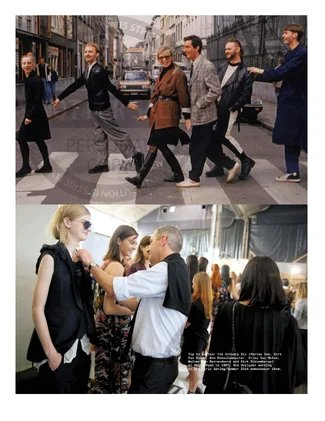
DVN. Walter Van Beirendonck's designs were inspired by London club culture and the performer Leigh Bowery. Ann Demeulemeester's style was very dark and romantic. Dirk Bikkembergs drew his inspiration from sports. Marina Yee was minimalist. Dirk Van Saene focused more on craftsmanship and tailoring. And as for me... That label they put on us, the Antwerp Six, is a bit strange when you really think about it. Because it implies that we were a homogenous group with a common aesthetic, whereas we all had extremely different styles. What brought us together was our friendship and a kind of common-sense attitude. We closed ranks to generate attention. I remember Ann Demeulemeester saying to me one day: "If they can pronounce 'Yohji Yamamoto,' they can say 'Ann Demeulemeester." [Laughs] We knew we had to get ourselves noticed, despite our extremely limited resources. Every now and then, there's renewed interest in the Antwerp Six, and people assume we had some kind of plan, a common strategy to get ourselves known. But honestly, there was no strategy at all. We operated from one season to the next, from one year to the next, improvising as we went. We'd ask our artist friends to model for us, because we couldn't afford "real" models. It wasn't a concept. The same was true of the underground venues where we held our shows. They were the only places we could afford.
É. You all ended up in London together in 1986, five years after you'd graduated, to show your respective collections.
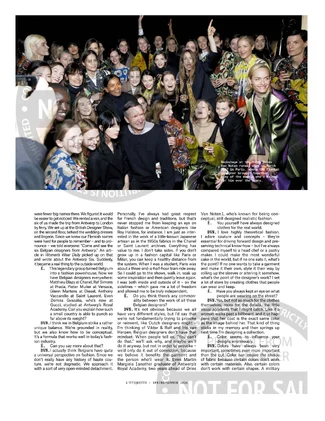
DVN. We'd all launched our brands, so we needed to get our collections out in front of as many people as possible. We were advised to go to Paris, but we preferred London because there were fewer big names there. We figured it would be easier to get noticed. We rented a van, and the six of us made the trip from Antwerp to London by ferry. We set up at the British Designer Show, on the second floor, behind the wedding dresses and lingerie. Since we knew our Flemish names were hard for people to remember and to pronounce we told everyone: "Come and see the six Belgian designers from Antwerp." An article in Women's Wear Daily picked up on that and wrote about the Antwerp Six. Suddenly, it became a real thing to the outside world.
É. This legendary group turned Belgium into a fashion powerhouse. Now we have Belgian designers everywhere: Matthieu Blazy at Chanel, Raf Simons at Prada, Pieter Mulier at Versace, Glenn Martens at Diesel, Anthony Vaccarello at Saint Laurent. Even Demna Gvasalia, who's now at Gucci, studied at Antwerp's Royal Academy. Can you explain how such a small country is able to punch so far above its weight?
DVN. I think we in Belgium strike a rather unique balance. We're grounded in reality, but we also know how to be conceptual. It's a formula that works well in today's fashion industry.
É. Can you say more about that?
DVN. I actually think Belgians have quite a universal perspective on fashion. Since we don't really have any history of haute couture, we're not dogmatic. We approach it with a sort of very open-minded detachment. Personally, I've always had great respect for French design and traditions, but that's never stopped me from keeping an eye on Italian fashion or American designers like Roy Halston, for instance. I am just as interested in the work of a little-known Japanese artisan as in the 1950s fabrics in the Chanel or Saint Laurent archives. Everything has value to me. I don't take sides. If you don't grow up in a fashion capital like Paris or Milan, you can keep a healthy distance from the system. When I was a student, Paris was about a three-and-a-half-hour train ride away. So I could go to the shows, walk in, soak up some inspiration and then quietly leave again. I was both inside and outside of it on the sidelines which gave me a lot of freedom and allowed me to be truly independent.
É. Do you think there's any commonality between the work of all these Belgian designers?
DVN. It's not obvious because we all have very different styles, but I'd say that we're not fundamentally trying to provoke or reinvent, like Dutch designers might I'm thinking of Viktor & Rolf and Iris van Herpen. Belgian designers don't have that mindset. When people tell us, "You can't do that," we'll ask why, and maybe we'll do it anyway, but not in order to provoke we'd only do it out of conviction, because we believe it benefits the garment and the person who'll wear it. Even Martin Margiela [another graduate of Antwerp's Royal Academy, two years ahead of Dries Van Noten], who's known for being conceptual, still designed realistic fashion.
É. You yourself have always designed clothes for the real world.
DVN. I love highly theoretical fashion. I adore couture and concepts they're essential for driving forward design and preserving technical know-how - but I've always compared myself to a head chef or a pastry maker. I could make the most wonderful cake in the world, but if no one eats it, what's the point? If no one wants to take a garment and make it their own, style it their way by rolling up the sleeves or altering it somehow, what's the point of the designer's work? I set a lot of store by creating clothes that people can wear and keep.
É. Have you always kept an eye on what people are wearing on the street?
DVN. Yes, but not so much for the clothes themselves; more for the details, the little visual accidents that I might catch. Like if a woman walks past a billboard, and it so happens that her coat is the exact same color as the image behind her. That kind of thing sticks in my memory and then springs up next time I'm designing a collection.
É. Color seems to influence your designs enormously.
DVN. Colors have always been very important, sometimes even more important than the cut. Color can inspire the choice of fabric because certain colors don't work with certain materials. Also, certain colors don't work with certain shapes. A military jacket in bright red fabric is quite risky but then, it can be magnificent. In my offices in Antwerp, I had a room where we kept all the fabrics we'd used in previous collections. Sometimes I'd pick up two of those old fabrics, and it would give me an idea. Color conveys a lot of emotions.
É. The Dries Van Noten brand has always stood out in the fashion industry, because such a colossal proportion of its revenues come from clothing rather than accessories.
DVN. That's something I'm very proud of, I have to say.
É. Were clothes always important in your family?
DVN. You could say that. My grandfather worked in a rather obscure trade. He was what was called a "garment turner," meaning he wasn't exactly a tailor, but his customers would bring him their worn suits, and he would unpick all the seams, turn the fabric over so the inside became the outside, and then he'd sew them back together again. That basically doubled the lifespan of the suits. It was fairly standard at the time, in the early 20th century. After WWII, he expanded his business and began producing suits made to measure from standardized patterns, which was common then. Eventually, he bought a spinning mill, then a factory. When I was born, in 1958, the company was already being run by his sons, including my father. In 1970, my father left the business to open stores outside the city. As for my mother, she ran some multi-brand clothing stores in Antwerp. I remember how on Sundays, before we sat down to eat, she'd show us the tablecloth she'd chosen: "Look at this stitching, this embroidery, this lace..." She'd talk us through it all before the meal. In our family, clothes weren't romanticized they were things you wore, mended and sold.
É. You spent much of your schooling with the Jesuits. One naturally imagines a certain austerity in dress.
DVN. [Laughs] I had to wear a uniform: blue wool jacket, gray pants, white shirt, blue tie.
É. Did you like it?
DVN. I hated it. At the time, I was watching David Bowie on TV and discovering my homosexuality, while being stuck in a school that was as traditional as it gets. You can imagine how liberating it was to meet the other fashion students at the Academy...
É. You never left Antwerp. You had your offices there, at the port. Weren't you ever tempted to go and live somewhere else, like Paris?
DVN. No. For one thing, Antwerp is a really enjoyable city to live in. And for a long time, it wasn't expensive. For what you'd pay for a room in Paris or London, you could rent a whole house in Antwerp. That gives you the space to design. Fashion can be very intense. A lot of designers couldn't keep up with the frantic pace. And social media certainly hasn't helped. It can be very hard to deal with some of the vicious comments you get. I personally needed to keep myself at a distance. Fashion alone isn't enough for me; I also need to garden, to look at art.
É. Now that you're not in charge of designing the collections anymore, what does your daily routine look like?
DVN. I spend a lot of time in Venice these days; I'm not in Antwerp so much. [Laughs] In the winter, I don't miss Antwerp, but when I see the first photos of the magnolias in bloom, of the roses in the garden then I definitely miss it.
É. You're launching your own foundation in the coming weeks. Why did you set it up in Venice?
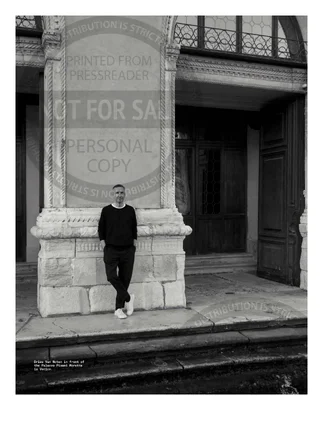
DVN. Let's call it a happy accident. Patrick [Vangheluwe, his partner in life and business] and I had known for ages that after we quit the fashion industry, we wanted to establish a foundation focused on craftsmanship preferably in Belgium, where we had our ties. But three years ago, we spent 10 days in Venice and discovered another side of the museum city; the vibrant day-to-day life, with no cars or bicycles, living at a completely different pace. We realized that this was where the foundation had to be based. We began looking for a place that wasn't too big, too ornate or too fancy. And we found exactly the opposite in the Palazzo Pisani Moretta! When we met its former owner, Maurizio Sammartini, whose family had owned the palace for 400 years, we were both bowled over. Since inheriting it in 1968, he's devoted his life to renovating it, and it's a joy to hear him talk about it.
É. What made you want to set up a foundation devoted to craftsmanship?
DVN. Working with artisans has brought me so much throughout my years as a designer that I wanted to give back a little of what I've received, through a project that would enable me to work with young people. Maybe it's a bit selfish, but I need to be surrounded by young people to function. At the studio, my team was always very young - the average age would've been around 30. I was afraid of stepping away from fashion and finding myself surrounded only by people of my own age. I didn't want to lose touch with that youthful energy.
É. Your foundation's first exhibition is called "The Only True Protest Is Beauty."
DVN. It's a reference to a line by Phil Ochs, an American folk singer and songwriter from the 1960s known for his protest songs. Beauty is often reduced to a purely aesthetic concern, but it can have many dimensions. Beauty can be soothing and raise questions, but it can also be provocative. I had a very strict Jesuit education, but I never really fit into that system. For me, cultivating beauty was a form of rebellion and resistance.
É. Paradoxically, you don't show that rebellion outwardly. You always dress in a navy-blue sweater, chinos and a white T-shirt. How did you come to this uniform?
DVN. When you design clothes, you're making hundreds of decisions every day. You're choosing colors, fabrics, buttons... The last thing you want is to have to make yet another decision. I solved the problem with a uniform. I used to do the same thing at restaurants. I'd always order the daily special, so I wouldn't have to choose.
É. But do you still enjoy buying clothes?
DVN. Of course! Last Saturday, I was at the Dries store in Antwerp. I can get a special discount! [Laughs]