Meisel was hired as an illustrator by Women’s Wear Daily. “I adored him,” says his boss, James Spina, then an art director at Fairchild Publications. Meisel arrived with an “awesome, amazing portfolio.” He immediately won a place in a department he would later describe as “a snake pit.” He still lived at home, “just like the Beaver in a garden apartment,” Spina, a neighbor, recalls. Meisel would drive Spina home in a Plymouth Scamp his father bought him to keep him off the subway. Together, they would pore through Meisel’s extensive collection of old fashion magazines as they sat beneath posters featuring the likes of Ve-ruschka and Mott the Hoople.
At work, Meisel was modest and likable. He would sit around the office creating characters and monologues. “We’d discuss trends, personalities, the sixties — when women actually wore five pairs of earrings,” says Robert Passantino, a WWD colleague. Sometimes the male illustrators played dress-up. “They’d bring beaded Norells in and try them on,” says an editor. Meisel joined in, only he’d put dresses on over his jeans when he posed for the department’s dean, Kenneth Paul Block. “He seemed like a naive boy from Queens,” Block says. “He was quiet, good-looking, very focused, and really eager to be successful. That, one felt.”
By 1977, Meisel was illustrating page-one stories as well as spreads. Spina remembers that when the paper covered the new punk performers like Patti Smith and the Clash, Meisel did a series of “New Age, high-voltage” drawings to accompany the story. He was close to that scene. He’d go to Max’s Kansas City to see Smith play. His best friend from grade school, Richard Sohl, played keyboards in her group. Sohl would visit him at WWD, as would two designers: Anna Sui, an old friend from Parsons, and Stephen Sprouse, whom he’d met at a Bowie-era drag bar, the 82 Club, in 1974.
The clubland years had begun. “The scene was very flamboyant,” says Deborah Marquit, the Parsons classmate who, with Meisel’s help, got a job at WWD. “Everyone came to work crazy from the night before.” Gabriel Rotello, the ex-editor of Outweek, was just starting a career as a musician and nightlife impresario when he met Meisel and Co. at the Ninth Circle, a Village bar. Rotello, who went on to share a summer house with Richard Sohl, followed the group’s exploits for a decade. At first, Sohl was the star. Patti Smith would introduce him onstage as “Richard D.N.V. Sohl.” The initials stood for Death in Venice.
“Richard entertained us with stories of them coming into the city in junior high and going to gay bars,” Rotello says. “They had real wild streaks, wanting to be where the action was. Steven was very reticent, very nice, obviously very talented, very enigmatic. I –thought he manufactured his eccentricities as he might an illustration or a photo. For effect.”
Meisel and Sohl shared a conspiratorial streak. They would whisper in a private language and call each other names — Sissy Meisel and Tanta Ricky. “If you didn’t know the codes, you wouldn’t know what they were talking about,” Rotello says. “Together, I found them a little scary.” So did Marquit. “For them to accept you, you had to be arty, eccentric, or leaning towards homosexual,” she says. “I was straight and into guys. He found humor in my sexuality, but almost at the expense of my sexuality. He can appreciate Madonna’s talent. I don’t know if he can appreciate her as a sexual being.”
Teri Toye was more to Meisel’s taste. They met at a party at Rotello’s loft, jumping on his old sofa and breaking it. Arriving from Des Moines in the late seventies, Toye started Parsons as a boy, only to quit as a girl. Along the way, she modeled for an illustration class Meisel taught at Parsons. Together, the pair made quite a fashion statement.
Before he got his own Manhattan apartment on East 21st Street in about 1979, Meisel spent a lot of time visiting kindred spirits. “Steven’s idea of a fun evening was to come over, do my makeup and hair, put something crazy on, take a photo, and go out,” says a friend. “He was a Svengali. He’d always concentrate on the other person.” His exhibitionistic set was glad to oblige him. The times were wilder than Meisel. Though many people around him were drinking and drugging and having oblivious sex, says Rotello, “Meisel always seemed a little too dignified to be caught with his pants down.” He had the same companion for years.
More recently, with the safe-sex posters he shot for Red, Hot, and Dance, an interview in the Advocate, and the Madonna book, Meisel has opened up a bit. He said he’s always photographed “more effeminate-looking men, more mas-culine-looking women, and drag queens” in hopes of “teaching that there’s a wide variety of people. . . . There’s absolutely a queer sensibility to my work . .. but there’s also a sense of humor … a sarcasm and a ‘f — you’ attitude as well as a serious beauty.”
To Danny Fields, a journalist and rock manager, Meisel’s clique appeared asexual. “They dressed like Arab women in mourning,” he jokes: “How could you unwrap that? They were like an order of nuns. They just went places and were special. They meant no harm. They tried to look more scary than they were.”
Meisel’s photographic career began in-auspiciously. Illustration was passe. “There wasn’t a lot of work to be done,” Marquit says. “We were all getting very depressed. Steven took up photography.” One night, Spina took Meisel to a party for Bette Midler. Meisel borrowed an old Exakta and took a picture that ran in WWD’s “Eye” column. As a continuing-education teacher at Parsons, he was entitled to take courses, and chose one in photography. His parents bought him a camera.
In 1979, Meisel met Valerie “Joe” Cates, an aspiring model from Park Avenue, in a vintage-clothing store. He asked to photograph her and her sister, Phoebe, a top model at Seventeen. Through the Cates sisters, Meisel got work shooting test photographs of young models — and an assignment from Seventeen. “The next time we wanted him, we couldn’t get him,” says Tamara Schneider, who was then the art director.
In the interim, Meisel had sought out Annie Flanders, who’d owned the influential sixties boutique Abracadabra (a haunt of the young Meisel) and become the style editor of the Soho Weekly News. She published his first coyer photo.
Flanders knew that her friend Frances Grill, a photographer’s agent, was looking for new blood. Grill was impressed with Meisel and immediately sent a carousel of his slides to Kezia Keeble, a stylist who’d once worked for Diana Vreeland. “She refused to come out of her bedroom to look at them,” Grill says. Keeble’s husband at the time, Paul Cavaco, looked at the slides against their door. “Come out of the bedroom,” he told her.
It was clear, as Keeble would later put it, that “Steven Meisel was it.” She got him jobs with Charivari and WilliWear. Then she was hired to create covers for Conde Nast’s Self magazine. Meisel had never worked in a studio, and he didn’t want to leave his WWD job. “He technically knew nothing,” Grill says. “He was really insecure.”
Still, in the early eighties, Meisel shot half a dozen Self covers with Keeble, helping turn the new magazine into a million-selling success. He was also working regularly for Mademoiselle; its Italian equivalent, Lei; and, every once in a while, Vogue.
An assistant — who was “promised tons of work by Kezia Keeble to show Steven how to do it” — would set the lights and the camera, says an insider. “Steven didn’t know the front of the camera from the back. Kezia wanted a photographer she could mold. He was her boy.”
Christopher Baker, another assistant, agrees that Meisel didn’t know much. “He didn’t care. It was weird,” Baker says. “He was, like, chosen.”
Editors loved his perfectionism and his style. Wearing a dirndl skirt over jeans, he was “always pushing the limit,” Andrea Robinson, then a Vogue editor, recalls. “He’d speak to the model in sign language, put his hand a certain way, throw his neck, and expect her to imitate him.”
Around that time, Meisel won an assignment from Vogue to shoot the Paris collections. “I had to fire him so he could get going on his photo career,” James Spina says. The paper soon felt the loss. “He was a genius, and we were fools not to try and keep him,” says WWD chairman lohn Fairchild.
In January 1983, Stephen Sprouse asked him to photograph some clothes Sprouse had been making. The designer — aided and abetted by Meisel’s image-making skills — was an immediate hit.
Suddenly, Meisel’s posse was in the limelight — literally. The Limelight opened late in 1983, and Toye and Meisel used the occasion to announce their mock engagement. “It was a ‘Let’s play with their heads’ thing, a joke,” says party promoter Alan Rish. But the reaction was unexpected. “That was probably the beginning of the end for downtown,” says Ira Silverberg, a book editor who was the doorman at the Limelight that night. “It went from small to big. Everyone became someone. They weren’t just hanging out anymore.”
That fall, Sprouse held his first commercial show, and Meisel met Madonna, shot her album sleeve, and photographed her for Mademoiselle. Then, in the spring of 1984, Keeble and John Duka, the New York Times fashion columnist who was about to become both her fourth husband and her and Cavaco’s partner in a P.R. firm, ran a fashion show where they declared Toye the Girl of the Year. One friend refers to what followed as “their little Peyton Place.”
“It was intensely intimate,” says hairstylist Maury Hopson. “Then it was intensely estranged.” Meisel, Sprouse, and Toye stopped speaking. Toye wrote it off as a “high-school girls’ fight.”
Frances Grill, who also began seeing less of Meisel at the time, thinks his frequent fallings-out stem from boredom. “He is fashion,” she says. “Fashion itself. As fast as you think you’ve got it, it changes. That’s how Steven is. He moves on.”
Others talk darkly of sex and drugs. “It was a time when people were toying with dangerous things,” says someone who shared a loft with a friend of Sprouse’s. “People realized that, left town, got new lives.”
Toye married art dealer Patrick Fox and moved back to Des Moines, where they now restore Victorian houses and are active in local politics. Sprouse went into and out of business twice and is now trying another comeback. Only Meisel’s aim was true.
Following the breakup of the group, he began working regularly for both Italian and American Vogue. But as his profile rose, his problems multiplied. Often, his pictures were discarded. “He was ahead of his time, and that scared people,” says an editor he worked with then.


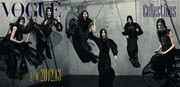
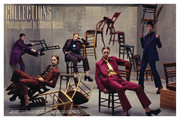
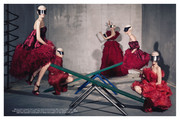
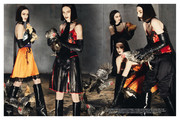
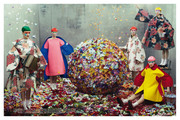
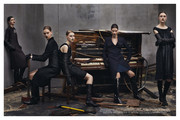
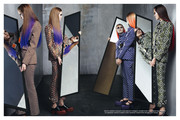
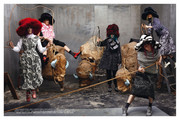
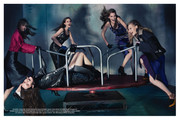
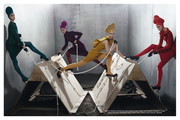
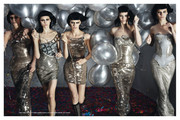
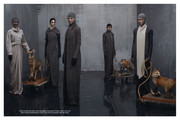







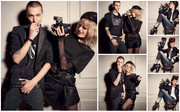


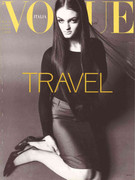

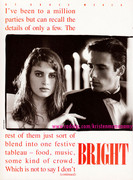
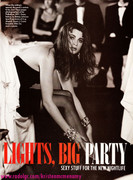
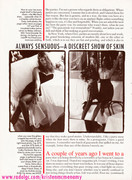
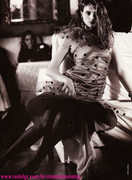


 Definitely one of Meisel's best. The mood couldn't be more perfect plus the casting of Hannelore.


