Not sure what sort of point you think you're making here. Yes, Karl became a caricature of himself and did so as a sort of armor. Now that he's dead, I think we have a duty to get through the armor—to evaluate the work on its own terms, to find areas of strength and moments of banality or kitsch. That's what is interesting to me about fashion, not the game of canonization people seem to want to play here.
no we don't have a duty to go beyond as it is what it is, his public persona and private person has been documented and written about and filmed,
i don't need more dissection of any mystery, he was a worker and got on with his life he embraced kitch as well as intelligent conversations all in its own appropriate time etc
he had bad collections and many good ones and what i value about Karl is less to do with the collections was more his work ethic and humor and constant drive to reinvent himself and not complan or be over dramatic with things in live yet be grand with luxuries .
i am well informed about is contributions and his status to me its clear.
new Chanel should be better than his and not repeat past mistakes that's what i am about.
even cathy horn says it:
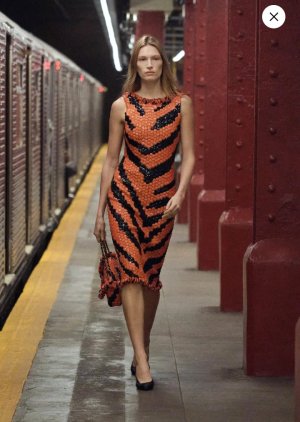
Did Blazy’s subway show work? The answer is no. The problem wasn’t that the setting was unglamorous, though it was, or even that showing luxury clothes there might verge on insensitive. Blazy and the Chanel team made it convincingly clear that they were treating the disused Bowery station as a set.
The problem was the expression wasn’t artistic. We were essentially an audience looking at 81 models, or characters, as they crisscrossed a platform.
Was there really a strong idea here? As a show, it failed, in my view,
to lift off and leave you with a sense of wonder or joy — as Blazy’s October show did.
Instead, it would have been far more effective and surprising if the audience had been sitting in a large empty space and, through the use of choreography and sound and lighting effects, we understood that we were meant to be on a chaotic platform for all the hours of a day. Our imaginations could do the work. Indeed, think of Marc Jacobs’s great show in February 2020, his collaboration with the dancer Karole Armitage, when the models evoked the energy of New York — without a set — and actually flowed into the audience, making us part of the action.
That level of artistry — starting from an abstract concept — would naturally have followed, if not surpassed, the buoyant effect of October.
vision