
You are using an out of date browser. It may not display this or other websites correctly.
You should upgrade or use an alternative browser.
You should upgrade or use an alternative browser.
Making Your Own Jewelry!
- Thread starter Elegance.Is.Refusal.
- Start date

Kimkhuu said:ATTITUDE and Sasa, those are so pretty and precious. I wish I could be able to make such beautiful jewelry!
THANKS.
More to come in a while.
The line went nuts, all of a sudden a lot of
people came to buy some of my earrings..
I'm going to get them online, just wait..
But it isn't hard to make them..
Just try it, or try to make some earrings..
I started by cut a old necklace and with a vork
I make everything together fit. Haha.

I had the best time of my life.
And now I get money for it,
not that you have to do the same,
but If you want some nice ones,
try to make it!

Anyway, thanks again.
Kimkhuu said:ATTITUDE and Sasa, those are so pretty and precious. I wish I could be able to make such beautiful jewelry!
thanks a lot Kimkhuu...
for those pieces i just put stuffs together and made it look beautiful by filling the spaces..hehe... trust me, they are not hard to make... just bring aroung all the thing that is looking gd then make once... u will have lot and a lot of fun~
(for crazy_K,
yours necklace look coooooooooool!
i guess it may be hard to paint those little parts~ good work!
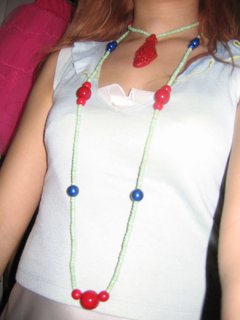
)DOOP.crazy_k said:I made this today out of old necklaces. I think I really like it. The red and blue parts are painted with nail polish, my head is still dizzy
veryvery nice.
keep it up!
wickedly_perfect
Member
- Joined
- Jan 13, 2005
- Messages
- 75
- Reaction score
- 0
Crazy_k, that necklace is awesome! I love the color of the blue beads.


*Happiness*
Active Member
- Joined
- Sep 2, 2004
- Messages
- 4,096
- Reaction score
- 1
Attitude, I really like the first pair. The second pair are ok. 
THNKS.*Happiness* said:Attitude, I really like the first pair. The second pair are ok.
yeah the black ones, were very easy to make.
nothing special. thnks for you comment.
ATTITUDE--I've been meaning to tell you that I think they are all great! Good work....have you thought about doing something similar with necklaces....I did some using old chains at different lengths and misc. charms/pendants/beads. It would add a nice "mix" to your collection since you've been selling the earrings so well.
Yeah, I already made some.purechris said:ATTITUDE--I've been meaning to tell you that I think they are all great! Good work....have you thought about doing something similar with necklaces....I did some using old chains at different lengths and misc. charms/pendants/beads. It would add a nice "mix" to your collection since you've been selling the earrings so well.
Forgot to make a picture..
I made them as a gift.. so..
But there's more to come,
never thought things would work out this way,
so much people want them.
I've made many more,
but ain''t gonna post all the pictures.
My next stop first is to make a website,
but I'm not a pro in that.. so still looking
for someone.. but it will end up just fine.
U made jewelry? PICTURES!
Thanks again, ciaao.
Thanks.Kimkhuu said:Attitude, I like the black cube earrings!
If people want some, just say it

PinkSunrise
Member
- Joined
- Jan 5, 2005
- Messages
- 222
- Reaction score
- 0
Attitude, I love the black cube earrings  how did you make them???
how did you make them???Thanks.PinkSunrise said:Attitude, I love the black cube earrings
I just bought the cube's and the gold chains and then just put them together. Kinda made me think at Chanel. But trust me, it was really easy. Maybe 10 minutes work?
I know not everyone is handy in these things or some, but for me..
I just buy these things, and with some music and food.. I'm sitting on the floor and within a few minutes I fix the most different and stylish jewelry.
As You Like It
Proponent of Plaid
- Joined
- Jan 17, 2004
- Messages
- 2,876
- Reaction score
- 1
I just got asked for a tutorial on how to make one of these 
You need:
1 or 2 pair of needlenose pliers
1 wire cutter
Spool of 18 or 20 gauge craft wire, depending on how thick you want the links to be. 18 gauge is thicker than 20. The above necklace is 20GA, but in the future, I will probably use 18 more frequently.
Beads, in whatever style and color you like. You can use anything from size 8 seed beads to FIMO polymer beads to carved wooden beads...your taste dictates!
Snip up a bunch of short lengths of wire. (I find it is handy to keep them on the upturned lid of an old yogurt cup. I use these to contain my beads, as well) The wire bits should usually be between 1cm and 2cm, typically, but if you have especially large beads, estimate for about 1cm longer than the bead itself.
Take a pair of pliers and bend a small loop in one end of a wire bit. It is usually sufficient to only make the loop as big as the tip of the pliers, though sometimes you need a bigger loop if the hole in the bead is especially large. Then, slide the bead on, and make a loop in the other end of the wire.
Start your second link by shaping the second bit of wire into the form of a J. Slip the hook of the "J" through the one of the loops on the first link, then use the tips of the pliers to close the hook of the "J" so that it is a loop. Add a bead to the straight end of the wire, and loop the open end closed. Add another link just as you did this one. Keep going in this fashion until the chain of beads and loops is as long as you would like. If you want a short necklace, you can add a spring or claw clasp to the very last loop, but if you wish to have a very long necklace, you do not need a clasp, as it should slip right over your head. Fun fact: the average woman's head measures 22.5" or 57.25cm! If you make your necklace a couple of inches or a few centimeters longer than that, you do not need a clasp.
If you want to have a dangly bit in the center, there are a couple of ways to do it. You can make a link like the very first one, then join both ends of the main strand to the top loop. You can also use a straight-pin with the sharp end snipped off, or a pre-made metal finding which looks somewhat like a super-long straight pin. You can also use things like flat filigree findings or pre-made charms as a central interest, if you are so inclined.

Here's an extreme close-up of some of the beads on my most recent necklace, and you can see how the links of loop-and-bead chainwork fit together.

Here's the central dangly bit, so you can see how I hooked two links to the central link of the lampwork charm.
I mention the use of two pair of needlenose pliers because sometimes, when you are working with very short wire bits and very small beads, it is difficult to hold the bead-and-wire steady while you are trying to create that second loop, and it would really be better if you could grip the straight end of the wire with one pair of pliers, right where it emerges from the bead, then use the other pair of pliers to form the loop. It requires an amount of manual dexterity, but it is much easier than it sounds when written out.

You need:
1 or 2 pair of needlenose pliers
1 wire cutter
Spool of 18 or 20 gauge craft wire, depending on how thick you want the links to be. 18 gauge is thicker than 20. The above necklace is 20GA, but in the future, I will probably use 18 more frequently.
Beads, in whatever style and color you like. You can use anything from size 8 seed beads to FIMO polymer beads to carved wooden beads...your taste dictates!
Snip up a bunch of short lengths of wire. (I find it is handy to keep them on the upturned lid of an old yogurt cup. I use these to contain my beads, as well) The wire bits should usually be between 1cm and 2cm, typically, but if you have especially large beads, estimate for about 1cm longer than the bead itself.
Take a pair of pliers and bend a small loop in one end of a wire bit. It is usually sufficient to only make the loop as big as the tip of the pliers, though sometimes you need a bigger loop if the hole in the bead is especially large. Then, slide the bead on, and make a loop in the other end of the wire.
Start your second link by shaping the second bit of wire into the form of a J. Slip the hook of the "J" through the one of the loops on the first link, then use the tips of the pliers to close the hook of the "J" so that it is a loop. Add a bead to the straight end of the wire, and loop the open end closed. Add another link just as you did this one. Keep going in this fashion until the chain of beads and loops is as long as you would like. If you want a short necklace, you can add a spring or claw clasp to the very last loop, but if you wish to have a very long necklace, you do not need a clasp, as it should slip right over your head. Fun fact: the average woman's head measures 22.5" or 57.25cm! If you make your necklace a couple of inches or a few centimeters longer than that, you do not need a clasp.
If you want to have a dangly bit in the center, there are a couple of ways to do it. You can make a link like the very first one, then join both ends of the main strand to the top loop. You can also use a straight-pin with the sharp end snipped off, or a pre-made metal finding which looks somewhat like a super-long straight pin. You can also use things like flat filigree findings or pre-made charms as a central interest, if you are so inclined.
Here's an extreme close-up of some of the beads on my most recent necklace, and you can see how the links of loop-and-bead chainwork fit together.
Here's the central dangly bit, so you can see how I hooked two links to the central link of the lampwork charm.
I mention the use of two pair of needlenose pliers because sometimes, when you are working with very short wire bits and very small beads, it is difficult to hold the bead-and-wire steady while you are trying to create that second loop, and it would really be better if you could grip the straight end of the wire with one pair of pliers, right where it emerges from the bead, then use the other pair of pliers to form the loop. It requires an amount of manual dexterity, but it is much easier than it sounds when written out.
 ).
).As You Like It
Proponent of Plaid
- Joined
- Jan 17, 2004
- Messages
- 2,876
- Reaction score
- 1

 as usual, click on thumb for full image.
My specialty is glass seed beads. This one is made mostly out of #14 hex beads. It is a choker which sits just above the collarbones and then the loops drape down over your shoulders, front and back, and the little tassel hands right in the hollow between your collarbones. I could not photograph it on my dummy as my dummy is maroon/red, too


Ankle bracelet for my sister. She told me her favorite macrame one broke, so I am giving this one to her. It should be very sturdy...it is strung on wire!


Details on another beaded choker. The "bars" of the ladder are "liquid gold" glass beads from Japan...they are twisted so they look like a stream of water. The little seed beads are an iridescent super-light pink (size #11), and the small bugle beads ae also gold color. The lampwork in the center was from a bag of assorted beads I bought back before Christmastime, when I was busy making presents. I think my sister might get this one, too, for her birthday She admires it, and it is a little big on me.


#8 seed beads form the "links" with #11 seed beads separating the links. The clear ones are hex faceted, while the greeny/black/purplish ones are just normal seeds. The #8s are a mix of colors/glazes, but with a predominant purple colorway, though there are some of the green/black/purple irridescent glaze ones in there.

softgrey
flaunt the imperfection
- Joined
- Jan 28, 2004
- Messages
- 52,984
- Reaction score
- 415
wow...we have some very talented people here...
ayli...you have so much patience to do that...did you take a class or just teach yourself all those variations?
attitude...i love your style...i would suggest a better earring piece...i think that the one you're using looks a bit 'cheap' (very thin wire)...and you chould charge more if you upgraded just that part...
ayli...you have so much patience to do that...did you take a class or just teach yourself all those variations?
attitude...i love your style...i would suggest a better earring piece...i think that the one you're using looks a bit 'cheap' (very thin wire)...and you chould charge more if you upgraded just that part...
Similar Threads
- Replies
- 52
- Views
- 54K
- Replies
- 3
- Views
- 2K
- Replies
- 88
- Views
- 22K
Users who are viewing this thread
Total: 1 (members: 0, guests: 1)


