MartiniKiss
Active Member
- Joined
- May 27, 2010
- Messages
- 36,766
- Reaction score
- 54
2013 Soul Train Awards held at the Orleans Arena on Friday (November 8) in Las Vegas.


justjared.com

2013 Soul Train Awards held at the Orleans Arena on Friday (November 8) in Las Vegas.
2013 American Music Awards held at the Nokia Theatre L.A. Live on Sunday (November 24) in Los Angeles.
FYI: Jennifer is wearing a Dior dress, Charlotte Olympia shoes, Sutra and Le Vian jewels, and carrying a Swarovski bag.


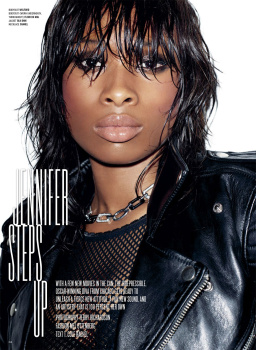
net-a-porterThrough self-belief and sheer talent, JENNIFER HUDSON rocketed from unknown hopeful to award-winning singer and actress. But, as JENNIFER DICKINSON discovers, she was always destined to be the ultimate modern diva.
When Jennifer Hudson accepted her Oscar for Best Supporting Actress in February 2007, it was an incredible moment for a number of reasons. Firstly, she is one of only a handful of actors to win an Academy Award for a debut role, in her case Effie White in Dreamgirls. Secondly, she was and still is the only American Idol contestant to have gone on to win such an accolade. Thirdly, unlike those who spend years working towards the achievement, Hudson had little idea of the significance of her win. “I didn’t know what the Oscars was,” she says. “Where we come from, we don’t know anything about that world. If you see it on TV, it’s like, ‘Oh, people in fancy suits and ties’.”
Down to earth is a description much overused when it comes to celebrities. Hudson, though, epitomizes it. Born and raised in a tough Chicago neighborhood, she still lives in the city with her fiancé, law graduate-turned-wrestler David Otunga, and their four-year-old son, David Junior. And, 10 years after she left her job on a Disney cruise ship to audition for American Idol, now with an Academy Award, a Golden Globe, a Grammy and over a million album sales to her name, she is still pinching herself. “It is so bizarre to me to say, ‘OK, let me go email Alicia [Keys], let me go email Beyoncé, let me go talk to Oprah...’. For so long I sat and admired them; now I’m among them,” says Hudson.
Not only among them, but respected by them. “Her voice can reach the heavens with beauty and precision,” says Keys, who worked with Hudson on The Inevitable Defeat of Mister & Pete. “She is phenomenally talented and not just as a singer. When you have a voice as powerful as Jennifer’s, it tends to be the thing everyone focuses on. What I loved about working with her on Mister & Pete was that we were reminded of what an incredible actress she is.”
It stands to reason then, that there is something of the diva about Hudson. Not that the 32-year-old exhibits any of the egocentric behavior associated with the term. No, Hudson has a diva’s unmistakable air of confidence, noticeable the moment she steps into the hotel suite, dressed in a caramel cashmere all-in-one. That confidence comes not from years of pampering or compliments, but simply from an unshakeable belief in her own talent and, strange as it may sound, in her destiny. “I used to babysit for my cousin and she came home and said, ‘You didn’t cook, you didn’t clean!’” remembers Hudson. “I replied, ‘I don’t cook.’ She said, ‘What you gonna do when you get married?’ I said, ‘I am going to be rich and have maids and cooks.’ And I was dead serious.”
American Idol was the first step towards that future. For the majority of contestants, these competitive reality shows lead back to the cruise ships Hudson started out on, especially if they progress no further than sixth runner-up, as she did (her early exit provoked accusations of racism). “What I feel about people you never hear from again is that they get too caught up in the hype. They think that just getting here is making it,” says Hudson. “No, it’s not making it. It’s like a losing-weight situation: it’s one thing to lose it, but it’s another to keep it off. Well, it’s one thing to make it, but it’s another thing to stay. [That is] why you have to constantly do stuff to keep people’s attention. It’s a hustle, it really is.”
The hustle became a lot easier two years after Idol, when Hudson won the Dreamgirls role alongside Beyoncé. “Jamie Foxx [her co-star] was like, ‘You know you’re going to win an Oscar?’” says Hudson. “I didn’t pay him any attention. I was hired to do a job. That’s all I knew.” From there, Hudson’s destiny unfolded the way she always predicted it would. Producer Michael Patrick King and Sarah Jessica Parker were such fans that they created a role for her in the Sex And The City movie, as a naive, small-town girl who arrives in the city looking for love. “Oh my God, that was my first time filming in New York, I was in the biggest whirlwind!” says Hudson. “Walking on the set, I was like [her character] Louise – I’m just this real normal girl who all these crazy things happen to.”
Her latest project, Black Nativity, where she plays a struggling single mother, is the first time since Dreamgirls that she has agreed to mix music and film. “I turned down I don’t know how many [musicals],” she says. “What drew me to this is that it’s a holiday film: I’m a holiday fanatic. It’s uplifting – we don’t have enough of that in the world.”
For Hudson, music is “like breathing”. One of her most poignant performances was singing in honor of Whitney Houston at the Grammy Awards after her heroine’s death. “As a girl I’d sit in my momma’s house and sing I Will Always Love You. That’s why [singing in tribute] was so overwhelming. I’m just grateful I got to meet Whitney. She came backstage and was like, ‘I turn my torch over to you; you are The One’. I was like, ‘Oh my God! Did anybody else hear that?’ Had she not given me her blessing, I would never have stepped on that stage.”
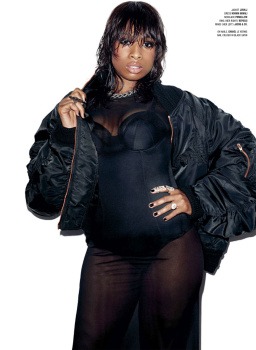
Hudson has also made headlines due to her significant weight loss, the highlight of which, she says, is the clothes she can now wear. Her favorite brands are Donna Karan and Givenchy, while Versace is her red-carpet go-to. “It is still very fresh in my mind, being a plus-size girl in Hollywood,” she says. “Now fittings are so much more fun.”
Juggling music, films and motherhood is a struggle, Hudson admits, but she was raised with a strong work ethic. “That’s one thing my mother always taught us. I don’t ever want to depend on someone else. I want my son to see that not everything is play. Every single thing I have, I worked for.”
The lessons Hudson’s mother, Darnell Donnerson, taught her have become even more important since Donnerson was murdered, along with her son and grandson, in 2008. In May 2012, the estranged husband of Hudson’s sister, Julia, was sentenced to three life sentences for the killings. While their deaths have irrevocably changed Hudson, she has refused to allow it to define her, so who are we to use articles such as this to let it? Too many have centered around the tragedy in her life, rather than on the fact that she has refused to let it quash her optimism. “We used to live in this high-rise building in Chicago and [you could see] the whole city,” recalls Hudson. “I’d face [my son’s] highchair towards that view. I wanted him to see the world before him and say, ‘Anything is possible’. It takes me back to my mother. She’d say, ‘Jenny, you can’t do everything.’ And [I’d say], ‘I’m doing a bit of everything now!’