http://www.moderntimes.com/palace/film_noir/
[FONT=verdana, arial, helvetica]
[/FONT] [FONT=verdana, arial, helvetica]
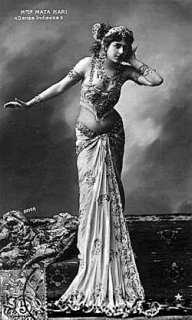
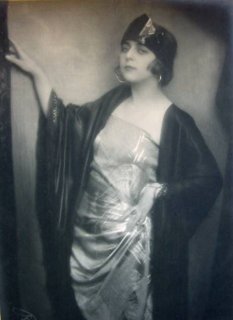
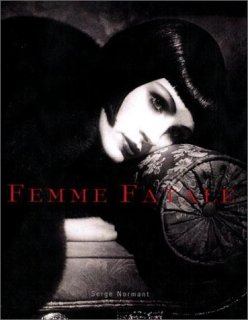
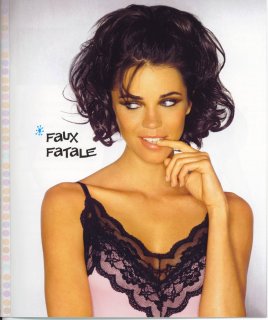
[FONT=verdana, arial, helvetica] Femme fatale—is defined as “an irresistibly attractive woman, especially one who leads men into danger or disaster”. To me the most engaging semblance of a “femme fatale” is the stunning image of Lana Turner, as the camera pans from her ankles upward in that breathtaking shot from “The Postman Always Rings Twice” 1946. [/FONT][/FONT]
[FONT=verdana, arial, helvetica][FONT=verdana, arial, helvetica]Extremes[/FONT][/FONT]
[FONT=verdana, arial, helvetica]
[FONT=verdana, arial, helvetica]The most consistent aspect of film noir, apart from its visual style, is its protagonists. If a usable definition of the noir protagonist is to be formulated, it must encompass its most intrinsic character motif—alienation. The undercurrent that flows through most “high noir” films is the failure on the part of the male leads to recognize the dishonesty inherent in many of noir’s principal women. This tragic flaw destroys the central male characters in films as diverse as “Scarlet Street” 1945, “The Locket” 1947, and “Angle Face” 1953. It's embodied in the John Dall character in “ Gun Crazy” 1949, whose youthful fascination with fire arms eventually leads him into a relationship with a woman who not only shares his “gun craziness” but who also introduces him to the parallel worlds of eroticism and violence. A more extreme example of this confusion is exemplified with Dana Andrews in “Laura” 1944, and Edward G. Robinson in “Women in the Window” 1944. Robinson and Andrews are fascinated initially not by the flesh and blood women, but merely by paintings—images of them. [/FONT][/FONT] [FONT=verdana, arial, helvetica]
[FONT=verdana, arial, helvetica]The overtly Freudian aspects of such relationships function as a foundation on which to construct a sequence of narrative events that typify the noir vision. Many of these male “victims” are not trapped exclusively by sexual obsessions. Fred MacMurray in “Double Indemnity” 1944, initially considers whether he is capable of committing murder for a woman. Then he thinks about effecting the perfect crime (his entanglement with Phyllis’ phony insurance claim), “It’s beating the house”, he thinks “sort of like the croupier that bets on the turn of the roulette wheel, when he knows the numbers to play”. [/FONT][/FONT]
[FONT=verdana, arial, helvetica][FONT=verdana, arial, helvetica]Detour[/FONT][/FONT]
[FONT=verdana, arial, helvetica]
[FONT=verdana, arial, helvetica]Edgar Ulmer’s Poverty Row cult-classic, “Detour” 1945, is fraught with outrageous coincidences that in most accounts would be far too absurd to confront, but in Ulmer’s skilled hands are accepted as legitimate premises. Tom Neal plays Al Roberts, a disgruntled piano player in a New York night club. When his fianc�e walks out on him for stardom in Hollywood, he decides to fellow her, and sets out to hitch hike west to join her. He gets picked up by a oddball character played by Edmond MacDonald who is carrying a large sum of money and happens to be driving all the way to California. MacDonald relates a story to Robert’s about a female hitch hiker he picked up earlier. In a blundering attempt to ravish her, she viciously attacked him, her finger nail marks clearly discernible on his face. As Roberts takes a turn driving, the MacDonald character mysteriously dies. Roberts thinking that the police will not believe his innocence in MacDonald’s bizarre death, hides the body and drives on alone. The next day Roberts picks up Vera, played with absolute aplomb by the very underrated Ann Savage. He has no idea that she is the same women who attacked MacDonald the day before. Vera questions Roberts about the MacDonald character’s death, not believing his story, she nevertheless advances a scheme whereupon Roberts will assume MacDonald’s identity and secure an inheritance for which MacDonald was making the trip to California. But circumstances beyond her control develop, and Vera is trumped. [/FONT][/FONT] [FONT=verdana, arial, helvetica]
[FONT=verdana, arial, helvetica]
The tawdry complexity of Vera—complete with strange classical allusion: Vera is compared to both Camille and Caesar in dialogue that is well up to the riotous standards set by other portions of the script—owes much to the performance of Savage¹ [/FONT][/FONT]
[FONT=verdana, arial, helvetica][FONT=verdana, arial, helvetica]Ultimate Femme Fatale[/FONT][/FONT]
[FONT=verdana, arial, helvetica]
[FONT=verdana, arial, helvetica] “Out of the Past”, 1947, while not a perfect example of the best of the noir cycle, contains many of the elements of the genre. It is best remembered as the film that introduced the erotic and lethal Jane Greer. The beautiful dark-haired Bettejane Greer came to Hollywood in 1945, a “B” player, she appeared in such obscure notables as “Dick Tracy” 1945, and “The Falcon’s Alibi” 1946. Out of the Past was one of only three noir films in which she appeared, the others being, “They Won’t Believe Me” 1947, and again opposite Robert Mitchum in the “Big Steal” 1949. Greer appeared in nine additional films through 1957. She took a brief hiatus until the mid-1960s, and has appeared off and on since. [/FONT][/FONT] [FONT=verdana, arial, helvetica]
[FONT=verdana, arial, helvetica]
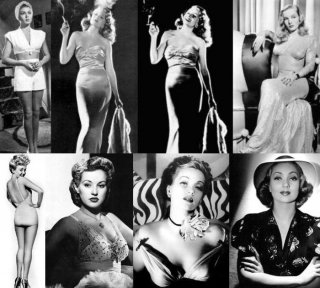
Jane Greer was the “real deal”, unlike many of the frivolous noir semi-goddesses (Lauren Becall, Martha Vickers, Jane Russell, or Laraine Day), her sexiness was derived from sheer cunning. She did not rely on the parodistic flirtations so common to the counterfeits of the genre—while entertaining actress, they lacked the appeal and darkness of the authentic femme fatale. A fine actress, I’ve always wondered why Greer did not become an icon of the genre in the mold of Gloria Grahame or Lizabeth Scott. She possessed the perfect on-screen persona of a post-war desolation angle. When Robert Mitchum firsts encounters her in the Mexican caf�, in an early scene from Out of the Past, she describes the complete night spot where he might feel more at home, and as she turns to walk away she tells him, “I sometimes go there”. At that moment we sense the hero’s ultimate calamity. Later we witness her brutally kill two men, and as Mitchum watches in terror, we cannot be confident that in the end he will not wind with her, such is the power of her sexuality. [/FONT][/FONT]
[FONT=verdana, arial, helvetica][FONT=verdana, arial, helvetica]Later Femme Fatales[/FONT][/FONT]
[FONT=verdana, arial, helvetica]
[FONT=verdana, arial, helvetica] Robert Siodmak’s, “The Killer’s” 1946 and “Criss Cross” 1949 are fine examples of Universal’s contribution to the noir cycle. In both films it’s the deadly female who topples the hero. Another Siodmak offering is the much downplayed, “The File on Thelma Jordon” 1950. Here Barbara Stanwyck portrays a different type of femme fatale than her Phyllis Dietrichson character in Double Indemnity, whom Thelma resembles in method and motivation. This time she ensnares Wendell Cory, playing assistant district attorney Cleve Marshall. Marshall is much more innocent that Fred MacMurray’s Walter Neff, who admits trying to “beat the house”, well before he meets Phyllis. From the beginning Thelma loves her victim, whereas Phyllis was not smitten until the very end in Double Indemnity. Where Phyllis and Walter are chillingly logical in their scheme, Thelma and Cleve are guilt-ridden, and clumsily romantic. In the end Cleve is not completely ostracized, or dead as was his counterpart Walter Neff. He is however, scarred immeasurably—an emotional Sisyphus, he must now forever bear the weight of his misdeeds. [/FONT][/FONT]
[FONT=verdana, arial, helvetica][FONT=verdana, arial, helvetica]What Happened[/FONT][/FONT]
[FONT=verdana, arial, helvetica]
[FONT=verdana, arial, helvetica]The archetypal model of film noir had run it’s course by the mid-1950s. The requisite entry of that period, at least among most film critics of the day, was Robert Aldrich’s take on Mickey Spillane’s “Kiss Me Deadly” 1955, by then though Spillane had moved from the hard boiled pulp hero of the post-war years to the new antagonists of cold-war America, the new great fear of the moment—the “Commies”. Kiss Me Deadly was a greater influence on the French “New Wave” movement, than a further definition of film noir. [/FONT][/FONT] [FONT=verdana, arial, helvetica]
[FONT=verdana, arial, helvetica]By the late 1950s and into the 1960s, strong, tough, independent women were being replaced by coadjutors and consorts. “Leading Ladies” who, though portrayed as capable and self-reliant had, however, moved well into the background. A prime example is Doris Day in “Pillow Talk” 1959. And so to the male protagonists, who were now being portrayed as gallant Don Juan’s or attentive Casanova’s, a fashion that was to reach it zenith with the James Bond films. [/FONT][/FONT]
[FONT=verdana, arial, helvetica]
[FONT=verdana, arial, helvetica]To me, the “classic noir period”, spanned the interval just after World War II, until the early 1950s. The central figures portrayed in these films, were too often caught in their double binds, filled with existential bitterness. They were drowning outside of the social mainstream. They came to represent America’s stylized vision of itself, a cultural reflection of the mental dysfunction of a nation in uncertain transition. And often these characters were women, the femme fatales of a film style distinctly original, and wholly American. [/FONT][/FONT]
[FONT=verdana, arial, helvetica][FONT=verdana, arial, helvetica]¹Alain Silver and Elizabeth Ward, “Film Noir: An Encyclopedic Reference to the American Style” [/FONT][/FONT]
[FONT=verdana, arial, helvetica]
[FONT=verdana, arial, helvetica]Michael Mills, 1999 [/FONT][/FONT]



 i always end up running in heels when im about to miss a plane or something
  you think they are not femme fatales? the "femme fatale" is an old topos in literature and film, and the term is widely used for the female roles in the "film noir" so i think it's appropriate to consider those 'movie dames' when talking about the concept.
 )
)
 yahoo)

 )
)