Dilara Findikoglu - Designer, Creative Director of Dilara Findikoglu | the Fashion Spot

Dilara Findikoglu - Designer, Creative Director of Dilara Findikoglu

TurkicMongol

Well-Known Member
Joined
Jul 18, 2025
Messages
147
Reaction score
543

Former Dilara Findikoglu Employees Open Up About Their Negative Experiences at the Brand​

Interns, in particular, describe a culture of exploitation, toxicity and discrimination within the celebrated British fashion label.
*Some names have been changed to reference sources who spoke on the condition of anonymity due to fear of retribution.

According to the financial statements Dilara Findikoglu filed with Gov.uk for the year ending Jan. 31 2025, its studio had just one employee. On paper, the operation appears to orbit entirely around the founder's creative force and this single staff member. However, multiple sources say that in actuality, the studio relies on many more hands. Which leads to the uncomfortable question: How much of the brand's output may be attributed to the work of unpaid interns?

I want to paste the whole article but I can't with my phone, but I think the designer and her behavior/or the making of her work deserve her own thread. I feel sympathetic to the interns which reminds me of my own experience many years ago in the industry, but I just can't help but laugh out loud for the details they shared. 🤣
 

Former Dilara Findikoglu Employees Open Up About Their Negative Experiences at the Brand​

Interns, in particular, describe a culture of exploitation, toxicity and discrimination within the celebrated British fashion label.
*Some names have been changed to reference sources who spoke on the condition of anonymity due to fear of retribution.

According to the financial statements Dilara Findikoglu filed with Gov.uk for the year ending Jan. 31 2025, its studio had just one employee. On paper, the operation appears to orbit entirely around the founder's creative force and this single staff member. However, multiple sources say that in actuality, the studio relies on many more hands. Which leads to the uncomfortable question: How much of the brand's output may be attributed to the work of unpaid interns?

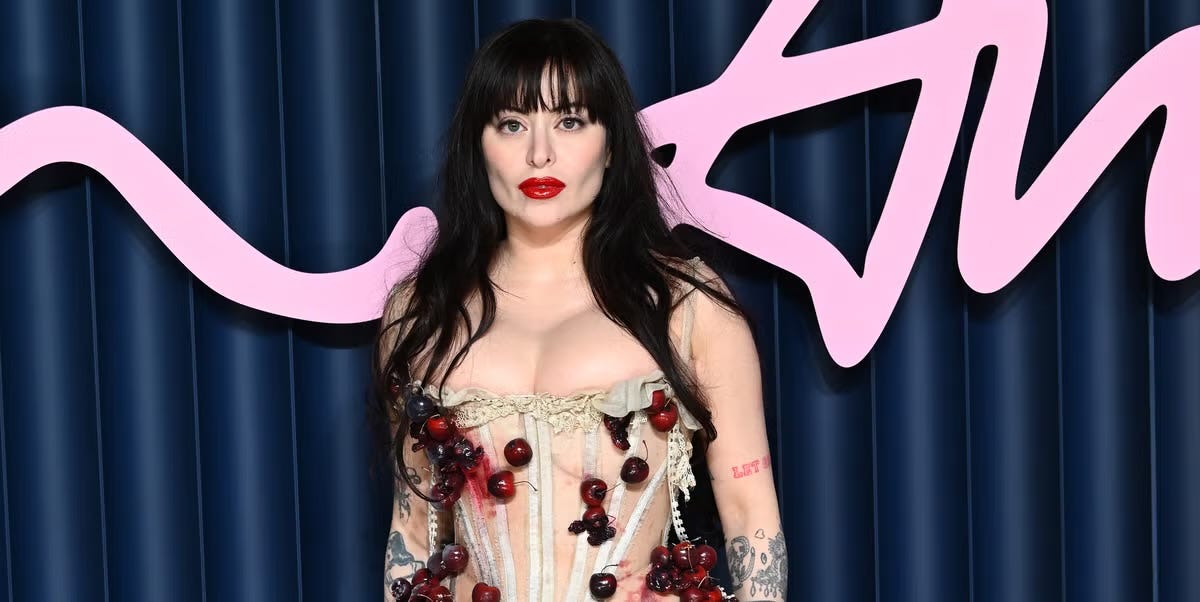
Though still an emerging label in London's hectic fashion scene, Dilara Findikoglu has conquered her space in it, dressing A-list stars like Kim Kardashian, Charli XCX and Margot Robbie; drawing critical acclaim for her buzzy, disruptive London Fashion Week collections; and receiving major industry recognition, including being shortlisted for the LVMH Prize and, just this week, winning the Vanguard Award at the 2025 Fashion Awards in London. Now globally recognized as a creative visionary "at the forefront of a new wave in British fashion," Findikoglu appears to be the picture of early industry success. But when you scratch past the surface, as is often the case, things are more complex.

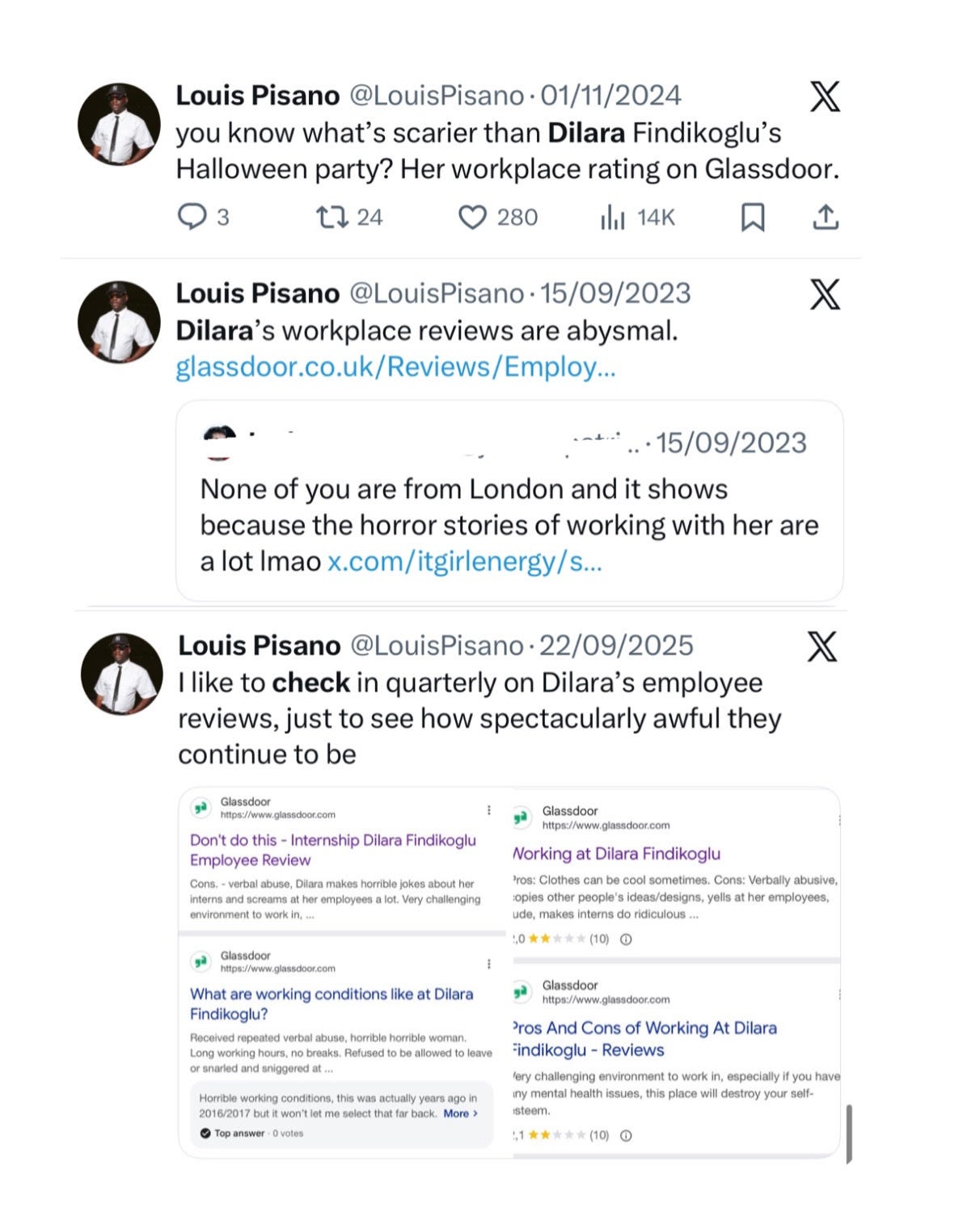
Allegations that point to the brand's toxic workplace culture have been floating around industry circles for a few years. They ignited when Louis Pisano, an American journalist based in Paris, mapped a pattern of reviews on Glassdoor, a website where current and former employees anonymously review companies. Pisano first fell down the Glassdoor rabbit hole in September 2023, while chatting with his usual fashion circle about internships — a constant obsession among his followers desperate to break into the industry. When the conversation turned to London, he says, someone casually tossed out the half-joking, half-serious line: "Oh, well, just don't send them to Dilara!"

"I was like, 'Oh, what's the tea?'" Pisano tells Fashionista. "And they said, 'Girl, go look at the Glassdoor reviews!'" Naturally, Pisano, ever the nosy observer — his words, not mine — dove right in. "There's not so many, but there's enough with the same similar story. And they're all mostly negative," he notes. Indeed, the reviews range from alleged stories of unpaid overtime to accounts of interns reportedly paying for seamstresses to experiences of verbal abuse. Upon being contacted to address the allegations included in this story, the Dilara Findikoglu studio told Fashionista it "prefers not to comment on this."

About a month after Pisano's social media exposé, designer Karina Bond dropped a TikTok detailing her experience from six years ago in an unnamed London studio that was flourishing on paper, but whose internship reality was far from glamorous. In the video, Bond revealed that she worked long hours without a lunch break, and, like the norm in so many London studios, no pay at all. Though Bond, who now operates her own label, has chosen not to comment further, she confirmed to Fashionista that the TikTok in question refers to her experience at Dilara Findikoglu.

Some London insiders have even claimed that Central Saint Martins students are no longer allowed to intern for the designer — a claim CSM's PR representative denies, stressing instead that the university "listens to student feedback and works collaboratively with employers to ensure positive working cultures."

"Everything you read is true," Andy* confesses. She worked at the studio full-time for a few months last year, having signed an NDA (of which she claims she never actually received a copy). The former employee describes her relationship with Findikoglu as cordial, with good moments she doesn't deny. And while Andy didn't experience anything directly she describes as toxic, what she observed was hardly the kind of introduction one hopes for when first dipping their toes into the fashion world.

"Nothing was covered," Andy says. Not the commute, not a sandwich, not even an Uber after a 16-hour day. The gaps in support stretched far beyond the basics, though. As Andy recalls, it wasn't uncommon for trainees to be sent out to buy fabrics, buttons and other materials with their own money. "They'd be given one of [Findikoglu's] cards, but it would never work," she claims. "There was never any money on it."

Lily*, who navigated the studio's earliest days as both intern and newly hired staffer, recalls the same pattern. "We were having to pay for stuff with our personal cards," she tells Fashionista, noting that she was still a student at the time and had no savings. "I would end up in situations where I would get minus-1,000, 2,000 [pounds] on my card. I couldn't pay my rent, I couldn't eat and when we would ask to get paid, [Findikoglu] would get mad at us.''

Years later, Andy tells me, the interns and staff settled secretly on a rule: Never use your personal credit card. What followed became a sort of ritual, she adds: The company cards would fail; trainees, defeated, would return empty-handed; and production was put on hold. (Yet somehow, she claims, when someone was sent out to pick up small indulgences like tea, makeup, roses, Gucci flip-flops, or a glass of prosecco, the card magically worked.) The studio's work was frequently held up, and the usual remedy was to work late into the night. As Andy recalls, evenings could stretch to 8 p.m., midnight, sometimes even two in the morning.

Harry*, who interned at Findikoglu's studio in 2023 and also signed an NDA, recalls the long hours as well. "Workdays usually ended around 8 p.m., occasionally stretching to 11 p.m.," he tells Fashionista. While he remembers his experience as largely positive — with celebratory moments like finishing photoshoots, prepping outfits for celebrities and pep talks that "motivated us to research the new collection" — he also describes the atmosphere as toxic and cold. "I witnessed some verbal conflicts between Dilara and other staff members, which could be stressful," Harry confides. "I was not directly targeted, though [Findikoglu] could be very demanding at times."

High-stakes moments were almost routine for Andy, but there's one in particular that still makes her wince, she says. "When a custom piece was due and someone was coming to collect it, and nothing had been bought on time, because there was never any money, interns would have to be sent in a cab, sewing on the way, just to pass the dress off to the person taking it," she alleges. "The pressure to finish on time, the lack of proper equipment, no lighting…how are you meant to complete this in a professional way?''

Lily, too, recalls incidences in which professionalism seemed to be lacking. "One time we had a fitting [for a] pre-collection," she says. "We got into the studio at 9:30 in the morning and worked straight through until 6:30, without being allowed to eat or even use the bathroom." She pauses. "I was fainting. I was fainting on the model. I couldn't focus. We couldn't focus anymore because we were so hungry and [Findikoglu] would just snap back at us to say, 'Go eat when you finish, you can see that this is not done, you finish that first,' whilst she ordered herself some pizza." Lily and her colleagues kept going, because, she says, stopping wasn't an option. By the time the fitting ended and Findikoglu left, they were so desperate that they ate her leftover crusts, she reports. "That's how bad it was."

With a full-time position that had her at the studio six days a week, in what Lily describes as a "9-to-9" system, she found herself loaded with responsibilities. "I was doing pattern cutting and draping and drawing and everything,'' the ex-employee shares. ''We would have to get her cleaners, book her cabs, book her appointments. We had to handle everything. Production, emailing, PR, make-up, booking, the seamstress!" All while keeping one eye on the phone in case her boss wanted more. "One day she made me change the cab because the cab smelled bad,'' Lily recalls, still shocked. According to her, the designer had even been banned from Uber for violating its community guidelines, leaving interns to manage her transportation entirely. "Bear in mind," Lily laughs dryly, "this woman takes 25 Ubers a day."

After two years, Lily quit, utterly drained, she says. "I was throwing up every morning before going in," she recalls, her voice trembling, the memory still haunting her.

Over the years, many interns have passed through the studio's walls. Andy, who has worked across multiple fashion studios in London, finds the sheer quantity at Findikoglu's studio astonishing. "The entire brand is built on interns," she reports. "Without that incredible manpower, there wouldn't be the brand or the exposure she [Findikoglu] has."

Spencer*, who interned at the studio last year, echoes these claims: "There were many interns and a lot of work to do." She spent long, hectic days in an atmosphere she describes as tense. There was purportedly no junior staff to share the load, only a studio manager, whom, she notes, was "treated much like the interns." Still, she and the other trainees did feel essential at times.

"We felt valued because the collection clearly couldn't exist without us, but there were no concrete gestures to acknowledge our contribution," she explains.

After working at other London studios, Spencer doesn't see Findikoglu's workplace culture as an isolated case, but rather as part of a wider pattern in the U.K. fashion industry, where "interns are often exploited, without contracts, unpaid, and used only as long as they are needed." One London-based source, for instance, describes an arduous schedule while working for designer Ashley Williams: "We were expected to work from 9 a.m. to 9 p.m., six days a week — sometimes seven — with no pay and only a lunch break." This level of demand of interns is unfortunately all too common in the fashion industry, especially within smaller, potentially under-resourced companies. But is it legal?

Under U.K. law, interns are only entitled to the National Minimum Wage if they qualify as "workers." Student placements (internships related to a higher education course or required by a school) and voluntary positions occupy a grayer, legally unremunerated zone, though they may occasionally qualify for minor consolations, like travel or lunch allowances.

A 2018 report by the British Fashion Council — the same institution that just awarded Findikoglu its Vanguard Award — addressed some of the systemic issues within the U.K. internship landscape. While the document offered no formal legal advice, it was drafted with input from legal counsel. One passage stated: "Where an organisation needs an intern (student or not) as part of its essential working requirements and the focus of the relationship is on productivity rather than personal development, the intern must be paid."

Although the BFC maintains a code of conduct on its website, it provides no formal channel for reporting wrongdoing by members. This leaves exploited interns with two options: Rely on UK law, which leaves more gray areas than clear protections, or turn to labor rights organizations, which remain largely marginalized from the mainstream fashion narrative.

At Findikoglu's studio, interns may have been hired under the guise of student placements, but as evidenced by the testimonies of Andy, Lily, Harry and Spencer, it would seem they were not simply learning the basics; rather, they were carrying the studio on their backs.

But then, the problems at Findikoglu's studio extended beyond the relentless and arguably exploitative reliance on unpaid labor, according to employee claims. Andy, Harry, and Lily all speak of other, equally troubling issues behind its walls.

"People were told that they can only speak English in the studio, but then they go behind and speak their language, Turkish, and are told that [others] can't," Andy recounts. Harry also witnessed language-based exclusionary behavior. And while Lily didn't, she did observe, she tells Fashionista, Findikoglu's frequent criticism of women.

"What bothers me is that she's pretending to be the biggest feminist on earth and it's an absolute lie," Lily claims. "She criticizes her fitting models. I remember her sitting on an app next to me, altering a fitting model's face: 'What if she had a smaller nose?'"

Andy says this sort of demeaning commentary from Findikoglu continued, even veering into prejudiced remarks: "She used to throw that word [ghetto] around quite a lot," she says, echoing Pisano's tweet citing another former employee's allegation that Black models were deemed "too ghetto" by the designer. According to Andy's account, it didn't stop there.

"The casting team is pushing for diversity constantly, as it should be in fashion, but [Findikoglu] would always say: 'oh my clothes aren't made for people like that,' 'because it's transparent it won't work on dark skin,' or, 'I don't want big models anymore because it's not elevated,'" Andy alleges, gesturing toward previous runway line-ups as the context for her comments. "She only liked using these white, ginger, almost Victorian-looking girls," she continues. "You can see it in everything she posts. That's why, if you look at the shows, there's usually just one Black girl, one curve girl."

According to Vogue Business's Spring 2026 Size Inclusivity Report, though London was the most size-inclusive of the big four fashion capitals, Findikoglu's runway featured neither mid-size nor plus-size models.

This lack of visible diversity, alongside the many accounts shared by former interns and employees at Findikoglu's studio, begins to erode the industry's carefully curated facade, revealing the troubling dynamics that seem to persist beneath it. As Pisano notes, fashion still operates under the belief that only the strong survive. "It's like Darwinism," he laments. This comparison might initially seem dramatic, but after hearing these stories, it lands just right.

None of the sources Fashionista spoke with brought legal action against Findikoglu's studio, largely because of NDA restrictions, but above all, out of fear, they say. Some claim they fought tooth and nail for money they were owed, but ultimately felt that challenging Findikoglu in court, with her financial leverage and social sway, as a battle already lost.

Now, Andy, Lily, Harry, Spencer and so many others carry on — some outside of the fashion industry — while others still hold out hope for the very system that has failed them. They remain bound together by NDAs, negative work experiences, outstanding pay and the bittersweet taste left by the fact that this studio, and many others like it, could have — and should have — done better.


Note: While Fashionista always prioritizes on-the-record reporting, our editors and reporters occasionally allow sources to remain anonymous at their request, as needed in order to protect them. In all such cases, any information or quotes we publish have been obtained firsthand and are believed to be newsworthy and credible.

fashionista.com

Wasn't this known already? There's definitely been social media posts, I guess this is the first proper report about this?
 
I have said it many times, but she gives me HUUUGE Nensi Dojaka vibes.
All buzz, no relevant substance and brand filing for bankruptcy or going into oblivion in the next 2 years. Her aesthetic is basically bodycon gothic OG Mcqueen, that's no depth in her work.
Getting Kim K dressed in one of your minidresses doesn't mean anything if there's no one buying your stuff.
 
...I’m more disgusted at the hideous concoction she's wearing that she hot-glued and stapled together in the photo used for that article, than any of the exploitive claims about her: She looks like she's plagued with extreme, exploding shingles. (…But her boobs look magnificent…)

(The most so-called prestigious retail menswear depot from my neck of the woods is more exploitive of interns and even professionals than the claims here of Dilara: Graphic design interns "hired" for professional roles and AD salary being way below industry standards-- while pushing $10, 000 suits. Way way way more exploitive than Dilara— of which unfortunately, has become just industry standard. My impression is if she were nicer to people, they wouldn’t mind her ways… The industry just gives many a license to be absolute jerks, sadly.)
 
(The most so-called prestigious retail menswear depot from my neck of the woods is more exploitive of interns and even professionals than the claims here of Dilara: Graphic design interns "hired" for professional roles and AD salary being way below industry standards-- while pushing $10, 000 suits. Way way way more exploitive than Dilara— of which unfortunately, has become just industry standard. My impression is if she were nicer to people, they wouldn’t mind her ways… The industry just gives many a license to be absolute jerks, sadly.)
In retrospect, I think what I hated most at that time(more than a decade ago) is that I didn't get paid so I gave up in less than a month because I had always been a realistic person and didn't worship any designer or brand. I would be okay with the intensity or even some abusive industry behaviors if I got paid for the minimum wage for the sake of not being exploited.
 
^^^The industry has always been exploitive, and unkindly so, to many extends-- just more unapologetically so these days with some, because perhaps they feel emboldened to be needlessly mean and use the defence that they’re a woman and they need to be a giant ***hole to make it etc etc. This becomes a vicious circle where those interns then will exploit others when they’re installed in a better role. It’s rare that people become more considerate, more kind and more generous after being exploited.

Her attitude is likely that these interns should be grateful/honored/privileged that she’s given them this opportunity. It’s the prevailing attitude of so many smaller brands like hers that have amassed some delusions of grandeur. I still get offers for so-called high profile roles— but the salary is just slightly above minimum wage while demanding several years worth of experience and skills in varied roles for the position. This industry deludes so many into believing that they’re so much more important than they could ever be. I had many models friends when I started, and one shared a story during a fashion week that was so hilarious and also so pathetic: Her mother agency had booked a large group of girls for a designer’s show, and one of the girls had just had success walking for and cast for the campaign of Alexander McQueen the previous season. And because of this, this model segregated herself from the rest of the group backstage and wouldn’t talk to the group. She made it clear that she was superior to the others. I can’t even remember her name now.

There are many less taleqtend but overly hyped people than Dilara And frankly, there are some decent, even solid design amongst the tiresome DeviantArt x Kat Von D aesthetic she predictably churns out season after season. That she is even considered a “visionary” is deliriously delusional. Thank goodness we can place our faith in genuinely talented women like Sharon Wauchob, Sarah Burton and Phoebe Philo.
 
Not surprising. London has always been the place for overrated designers in vein of Dilara and all of these other hyped labels championed by Dazed or i-D like it's default, all short on funding and mismanaged (a forever issue in London, I've been collecting articles and researching the issue during the 90s especially a lot recently) that fold quickly.
Nensi Dojaka
She gave off a vibe for me like she's just another in line of overhyped EE and Balkan, later Turkish designers that pop in London in every decade since the 90s, that are big on concept but often not good technique wise. Obsessed with prospect of studying at CSM and making it big.

London was and is, it's seen as, place for conceptual egdelords get traction.... but they can't survive. I feel it's the root of issues with LFW in general. I can't think about other FW that can have totally different set of labels presenting every 10 years. Anyone who did well or was good moved on. Galliano went to Paris, Westwood too, McQueen first for NYC and then for Paris. My favorite of the 90s London, Matthew Williamson, moved to NYFW by the 2000s...
 
^^^The industry has always been exploitive, and unkindly so, to many extends-- just more unapologetically so these days with some, because perhaps they feel emboldened to be needlessly mean and use the defence that they’re a woman and they need to be a giant ***hole to make it etc etc. This becomes a vicious circle where those interns then will exploit others when they’re installed in a better role. It’s rare that people become more considerate, more kind and more generous after being exploited.

Her attitude is likely that these interns should be grateful/honored/privileged that she’s given them this opportunity. It’s the prevailing attitude of so many smaller brands like hers that have amassed some delusions of grandeur. I still get offers for so-called high profile roles— but the salary is just slightly above minimum wage while demanding several years worth of experience and skills in varied roles for the position. This industry deludes so many into believing that they’re so much more important than they could ever be. I had many models friends when I started, and one shared a story during a fashion week that was so hilarious and also so pathetic: Her mother agency had booked a large group of girls for a designer’s show, and one of the girls had just had success walking for and cast for the campaign of Alexander McQueen the previous season. And because of this, this model segregated herself from the rest of the group backstage and wouldn’t talk to the group. She made it clear that she was superior to the others. I can’t even remember her name now.

There are many less taleqtend but overly hyped people than Dilara And frankly, there are some decent, even solid design amongst the tiresome DeviantArt x Kat Von D aesthetic she predictably churns out season after season. That she is even considered a “visionary” is deliriously delusional. Thank goodness we can place our faith in genuinely talented women like Sharon Wauchob, Sarah Burton and Phoebe Philo.
Dec 4th 2025 news
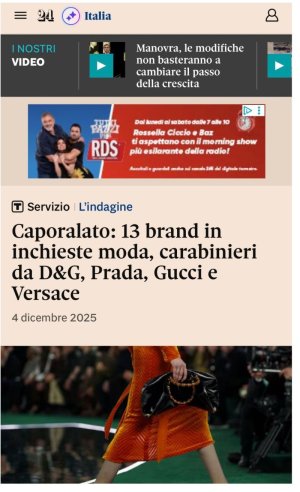
13 brands under investigation for labour exploitation: Dolce & Gabbana, Prada, Versace, Gucci, Missoni, Ferragamo, YSL, Givenchy, Pinko, Coccinelle, Adidas, Alexander McQueen Italia, Off White Operating (Tod´s as well in a separate case ongoing)
1764834369229-1.jpg
 
DISCOURSTED

DISCOURSTED


Read in the Substack app
Open app

so the Dilara Findikoglu expose finally came out​

let me tell you why nobody in fashion wanted to touch it.​

Louis Pisano
Dec 05, 2025
65
2
8

Happy Thursday, everybody. Hope you’re all doing well, except, honestly, one particular designer who’s probably not having the best week and deservedly so.

and no, I’m not talking about Dario Vitale, whose exit from Versace literally just hit WWD as I’m typing this sentence (wtf, I was rooting for you king) but rather about Dilara Findikoglu, who just won the British Fashion Council’s Vanguard Award, and then, almost immediately, got hit with a Fashionista investigation yesterday full of abuse, exploitation, and racism allegations, which I knew was coming.


DISCOURSTED is a reader-supported publication. To receive new posts and support my work, consider becoming a free or paid subscriber.

Subscribe


If you haven’t read Ana Reitz’s piece yet, please do. It’s rough. ( the story not the writing ). Former interns describe 16-hour workdays with no breaks, using their own credit cards to buy materials because the company card kept getting declined, and a whole list of comments that go from casually racist to just straight-up nasty. Multiple people say she used “ghetto” to describe looks, dismissed Black models because they didn’t fit her precious transparent silks, and rejected bigger models for not being “elevated” enough. It’s exactly the kind of stuff people assume happens in fashion but still wince when they see spelled out.

If you follow me on Twitter/X, none of this is new information. I’ve been pointing out the nightmare Glassdoor reviews for years. She’s reportedly been flagged to Central Saint Martins, the British Fashion Council, basically every institution in London. Everyone knew but nobody acted which is par for the course in fashion. That’s the part that always gets me, the jarring difference between what people openly discuss on Twitter and the absolute silence you get from the real-life fashion ecosystem. It was the same pattern with the Alexander Wang sexual assault allegations, Twitter had been talking about it FOREVER, industry people definitely knew, but it only became a “story” once it exploded online. ( Does anyone remember the Clubhouse space on it I co-hosted during lockdown? )


The thing people outside the industry don’t really understand is that reporting these stories is very very very complicated. People outside are like, “She’s allegedly abusing people, go write about it!” But inside fashion, there is an entire machine you’re up against. Everyone that’s attempted to write a piece on this has pretty much been told by the publications they pitched that it’s a no. Dilara has Lucien Pagès, one of the strongest PR firms in Europe…no actually maybe the world. If you want invites, access, brand relationships, basically if you want your career to function in any sort of outwardly fabulous way, you do not mess with their clients…or them. It’s that simple. You will most likely not see anyone at Conde Nast picking up this story, you for sure won’t see any of the fashion commentators whose cachet has been boosted by him posting about this, and you definitely won’t see any of the “cool” fashion writers here in Paris touching it for fear of getting locked out of a Byredo cocktail party.

Before I got myself completely blacklisted from every PR list in Paris for running my mouth or Twitter fingers one too many times, I had those conversations constantly. People were very direct: be careful who you criticize if you want to stay in the room ( let me tell you the amount of times I was told a lot more doors would open to me if I started writing more kindly about Jacquemus ). But anyways a lot of stories don’t get told for that reason alone.

I actually thought about investigating this a few months back, but people underestimate how emotionally heavy this kind of reporting is. When I did the Yeezy investigation, it drained the f*ck out of me. My boyfriend would see me anxiously pacing around the house at 4a.m on calls. You’re talking to people who are still processing what they went through. Their feelings change. One day they’re ready to talk, the next they’re scared or someone pressures them into backing out. It’s a lot to manage, and you want to treat their stories and trauma with care. So genuinely, credit to Ana for following through.

I remember someone once asked me, while I was reporting on the dark Carl Hirschmann ( founder of Heavensake ) sexual assault cases, “What’s your point?” And honestly, my point isn’t that anything is going to meaningfully change, there’s too much money moving around for that to happen, i’m a realist. My point is accessible information. I don’t want to be part of the crowd that knew all along and stayed quiet god forbid if something worse happens down the line. If you see something, say something. We need to democratize information, even if it doesn’t feel like it’s enough. ( By the way, in the end he never actually followed through with taking me to court, kind of hard to do when you’ve already been found guilty in a court of law for the very thing I reported on. During that whole situation, he even emailed every major PR agency in Paris—Lucien Pagès, KCD, Karla Otto, complaining about me and my reporting. That’s a glimpse of what’s at stake when you dig into these stories. Oh, and as a cherry on top, I’m now blacklisted again, right after they had started inviting me back to events, by his PR, Spread The Word due to reporting on him. I’m well used to this song and dance by now so no sweat. Life goes on ladies! )

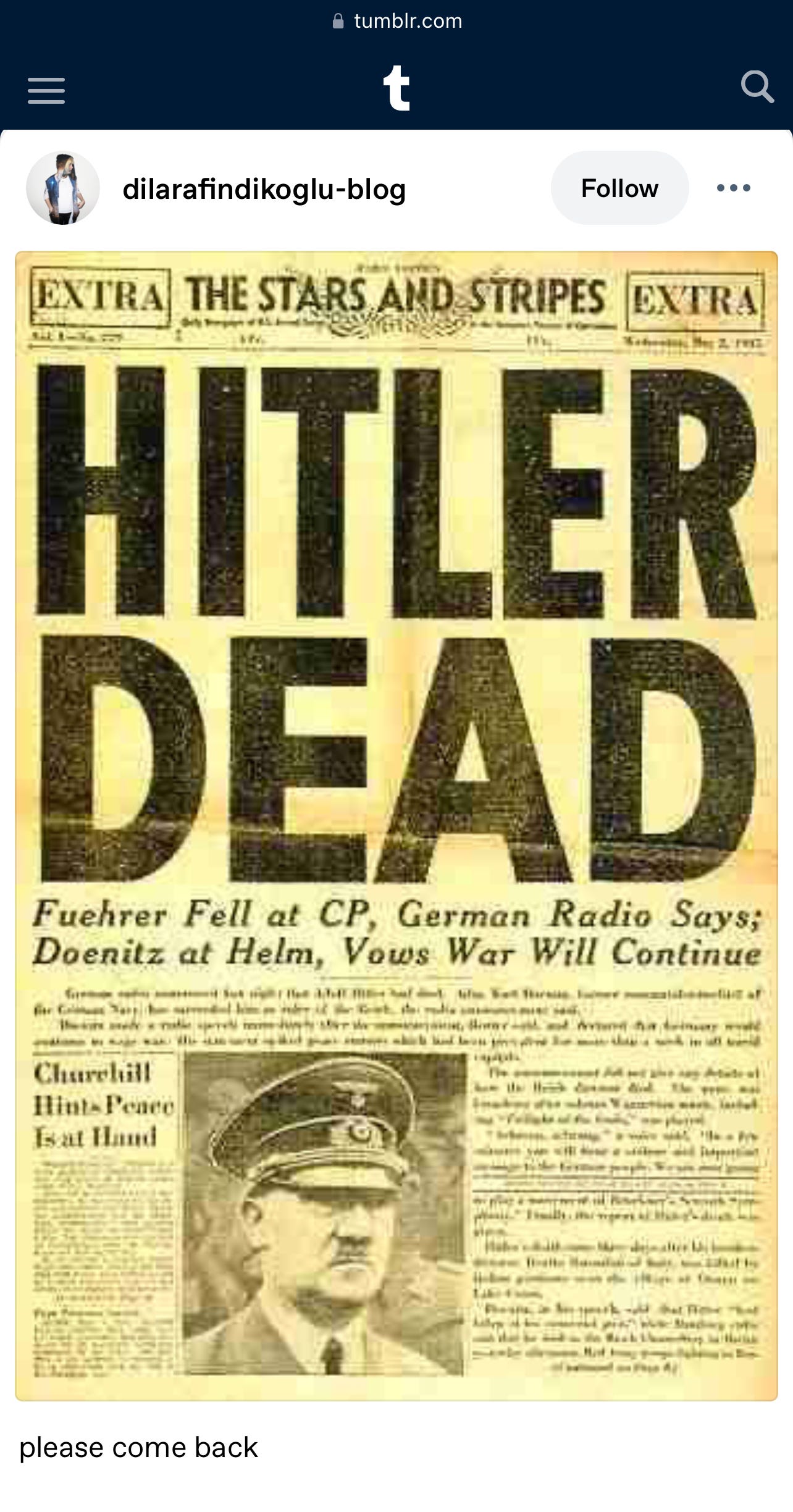
Anyways back to Dilara there’s also this conversation floating around that she is getting dragged so hard because she’s a woman, while men in fashion get away with far worse. And honestly? Men do get away with worse. John Galliano for example, Ludovic de Saint Sernin allegedly ( that’s another story that’s been bubbling under for a few years now ). I also have a theory (a messy but possibly true one) that gay men in fashion tend to excuse the behavior of other gay men because certain kinds of meanness and boundary-pushing are normalized in queer spaces. But that’s a longer conversation for another day. Bottom line is that Dilara had years of feedback, years of warnings, and plenty of opportunities to change. She didn’t. Eventually that catches up with you. Unfortunately for her there is much more to this story ( allegedly posting pro-Nazi content, design theft ) at the precipice of coming out.


Until then I hope she takes this situation seriously and starts treating the people who actually keep her brand running with some basic respect. Fashion is already exhausting. No one needs to be dealing with racism, 16-hour days, or buying fabrics on their personal AmEx on top of all that. The bar is low. Here’s hoping she finally decides to step over it.

DISCOURSTED is a reader-supported publication. To receive new posts and support my work, consider becoming a free or paid subscriber.


https://forums.thefashionspot.com/javascript:void(0)
 

Users who are viewing this thread

New Posts

Forum Statistics

Threads
215,459
Messages
15,303,521
Members
89,468
Latest member
hrrvntn
Back
Top