Former Dilara Findikoglu Employees Open Up About Their Negative Experiences at the Brand
Interns, in particular, describe a culture of exploitation, toxicity and discrimination within the celebrated British fashion label.
*Some names have been changed to reference sources who spoke on the condition of anonymity due to fear of retribution.
According to the financial statements Dilara Findikoglu filed with
Gov.uk for the year ending Jan. 31 2025, its studio had just one employee. On paper, the operation appears to orbit entirely around the founder's creative force and this single staff member. However, multiple sources say that in actuality, the studio relies on many more hands. Which leads to the uncomfortable question: How much of the brand's output may be attributed to the work of unpaid interns?
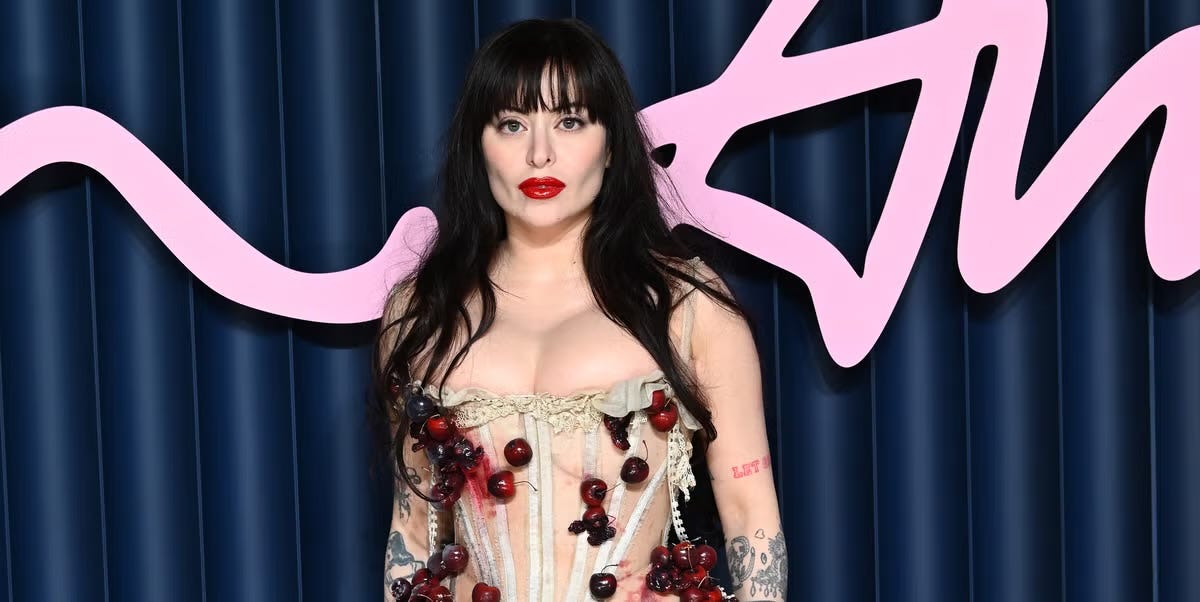
Though still an emerging label in London's hectic fashion scene, Dilara Findikoglu has conquered her space in it, dressing A-list stars like
Kim Kardashian,
Charli XCX and Margot Robbie; drawing critical acclaim for her buzzy, disruptive
London Fashion Week collections; and receiving major industry recognition, including being shortlisted for the
LVMH Prize and, just this week, winning the Vanguard Award at the 2025 Fashion Awards in London. Now globally recognized as a creative visionary "
at the forefront of a new wave in British fashion," Findikoglu appears to be the picture of early industry success. But when you scratch past the surface, as is often the case, things are more complex.
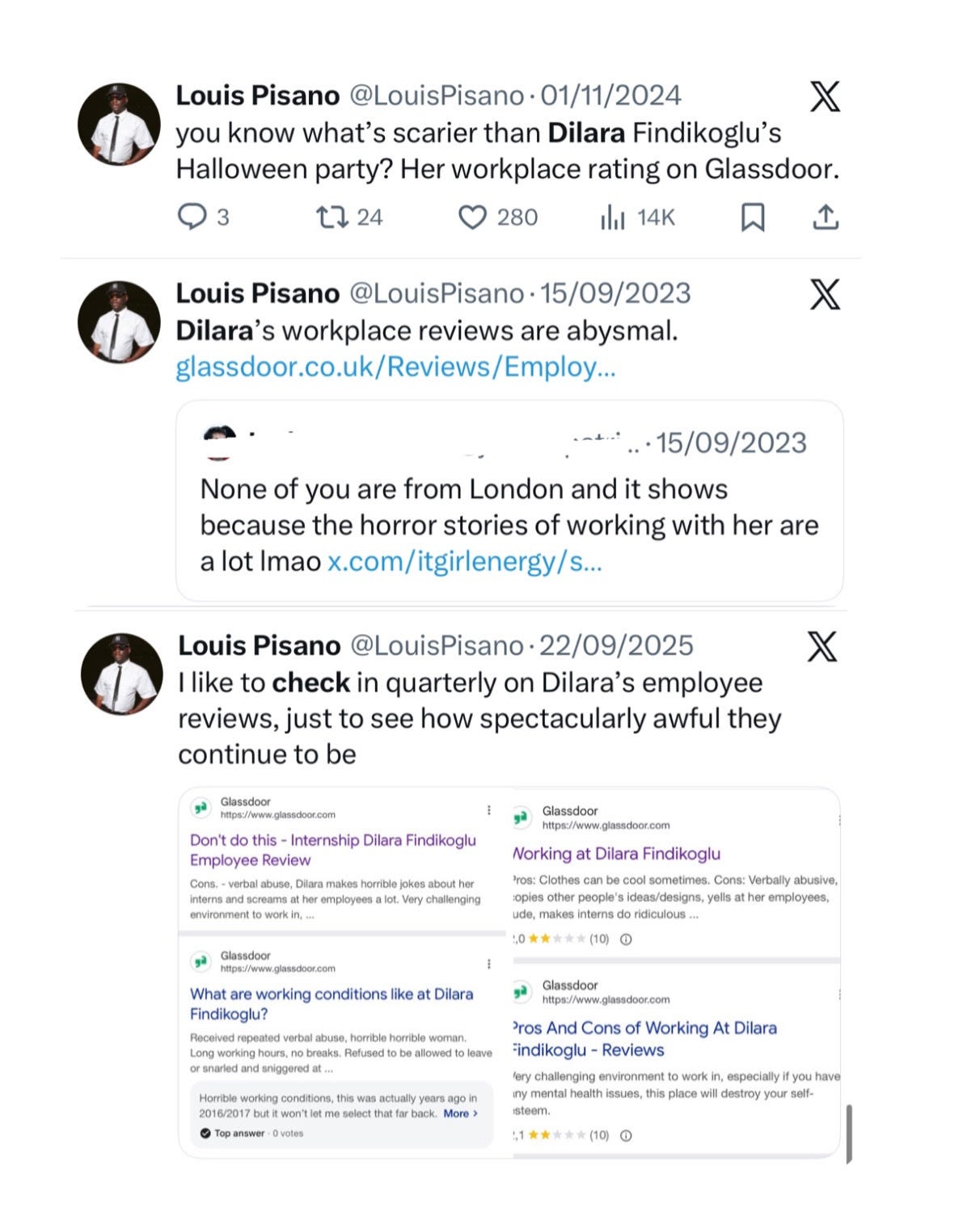
Allegations that point to the brand's toxic workplace culture have been floating around industry circles for a few years. They ignited when Louis Pisano, an American journalist based in
Paris, mapped a pattern of reviews on Glassdoor, a website where current and former employees anonymously review companies. Pisano first fell down the Glassdoor rabbit hole in September 2023, while chatting with his usual fashion circle about
internships — a constant obsession among his followers desperate to break into the industry. When the conversation turned to London, he says, someone casually tossed out the half-joking, half-serious line: "Oh, well, just don't send them to Dilara!"
"I was like, 'Oh, what's the tea?'" Pisano tells Fashionista. "And they said, 'Girl, go look at the
Glassdoor reviews!'" Naturally, Pisano, ever the nosy observer — his words, not mine — dove right in. "There's not so many, but there's enough with the same similar story. And they're all mostly negative," he notes. Indeed, the reviews range from alleged stories of unpaid overtime to accounts of interns reportedly paying for seamstresses to experiences of verbal abuse. Upon being contacted to address the allegations included in this story, the Dilara Findikoglu studio told Fashionista it "prefers not to comment on this."
About a month after Pisano's
social media exposé, designer Karina Bond dropped a
TikTok detailing her experience from six years ago in an unnamed London studio that was flourishing on paper, but whose
internship reality was far from glamorous. In the video, Bond revealed that she worked long hours without a lunch break, and, like the norm in so many London studios, no pay at all. Though Bond, who now operates her own label, has chosen not to comment further, she confirmed to Fashionista that the TikTok in question refers to her experience at Dilara Findikoglu.
Some London insiders have even claimed that Central Saint Martins students are no longer allowed to intern for the designer — a claim CSM's PR representative denies, stressing instead that the university "listens to student feedback and works collaboratively with employers to ensure positive working cultures."
"Everything you read is true," Andy* confesses. She worked at the studio full-time for a few months last year, having signed an NDA (of which she claims she never actually received a copy). The former employee describes her relationship with Findikoglu as cordial, with good moments she doesn't deny. And while Andy didn't experience anything directly she describes as toxic, what she observed was hardly the kind of introduction one hopes for when first dipping their toes into the fashion world.
"Nothing was covered," Andy says. Not the commute, not a sandwich, not even an Uber after a 16-hour day. The gaps in support stretched far beyond the basics, though. As Andy recalls, it wasn't uncommon for trainees to be sent out to buy fabrics, buttons and other materials with their own money. "They'd be given one of [Findikoglu's] cards, but it would never work," she claims. "There was never any money on it."
Lily*, who navigated the studio's earliest days as both intern and newly hired staffer, recalls the same pattern. "We were having to pay for stuff with our personal cards," she tells Fashionista, noting that she was still a student at the time and had no savings. "I would end up in situations where I would get minus-1,000, 2,000 [pounds] on my card. I couldn't pay my rent, I couldn't eat and when we would ask to get paid, [Findikoglu] would get mad at us.''
Years later, Andy tells me, the interns and staff settled secretly on a rule: Never use your personal credit card. What followed became a sort of ritual, she adds: The company cards would fail; trainees, defeated, would return empty-handed; and production was put on hold. (Yet somehow, she claims, when someone was sent out to pick up small indulgences like tea,
makeup, roses,
Gucci flip-flops, or a glass of prosecco, the card magically worked.) The studio's work was frequently held up, and the usual remedy was to work late into the night. As Andy recalls, evenings could stretch to 8 p.m., midnight, sometimes even two in the morning.
Harry*, who interned at Findikoglu's studio in 2023 and also signed an NDA, recalls the long hours as well. "Workdays usually ended around 8 p.m., occasionally stretching to 11 p.m.," he tells Fashionista. While he remembers his experience as largely positive — with celebratory moments like finishing photoshoots, prepping outfits for celebrities and pep talks that "motivated us to research the new collection" — he also describes the atmosphere as toxic and cold. "I witnessed some verbal conflicts between Dilara and other staff members, which could be stressful," Harry confides. "I was not directly targeted, though [Findikoglu] could be very demanding at times."
High-stakes moments were almost routine for Andy, but there's one in particular that still makes her wince, she says. "When a custom piece was due and someone was coming to collect it, and nothing had been bought on time, because there was never any money, interns would have to be sent in a cab, sewing on the way, just to pass the dress off to the person taking it," she alleges. "The pressure to finish on time, the lack of proper equipment, no lighting…how are you meant to complete this in a professional way?''
Lily, too, recalls incidences in which professionalism seemed to be lacking. "One time we had a fitting [for a] pre-collection," she says. "We got into the studio at 9:30 in the morning and worked straight through until 6:30, without being allowed to eat or even use the bathroom." She pauses. "I was fainting. I was fainting on the model. I couldn't focus. We couldn't focus anymore because we were so hungry and [Findikoglu] would just snap back at us to say, 'Go eat when you finish, you can see that this is not done, you finish that first,' whilst she ordered herself some pizza." Lily and her colleagues kept going, because, she says, stopping wasn't an option. By the time the fitting ended and Findikoglu left, they were so desperate that they ate her leftover crusts, she reports. "That's how bad it was."
With a full-time position that had her at the studio six days a week, in what Lily describes as a "9-to-9" system, she found herself loaded with responsibilities. "I was doing pattern cutting and draping and drawing and everything,'' the ex-employee shares. ''We would have to get her cleaners, book her cabs, book her appointments. We had to handle everything. Production, emailing, PR, make-up, booking, the seamstress!" All while keeping one eye on the phone in case her boss wanted more. "One day she made me change the cab because the cab smelled bad,'' Lily recalls, still shocked. According to her, the designer had even been banned from Uber for violating its
community guidelines, leaving interns to manage her transportation entirely. "Bear in mind," Lily laughs dryly, "this woman takes 25 Ubers a day."
After two years, Lily quit, utterly drained, she says. "I was throwing up every morning before going in," she recalls, her voice trembling, the memory still haunting her.
Over the years, many interns have passed through the studio's walls. Andy, who has worked across multiple fashion studios in London, finds the sheer quantity at Findikoglu's studio astonishing. "The entire brand is built on interns," she reports. "Without that incredible manpower, there wouldn't be the brand or the exposure she [Findikoglu] has."
Spencer*, who interned at the studio last year, echoes these claims: "There were many interns and a lot of work to do." She spent long, hectic days in an atmosphere she describes as tense. There was purportedly no junior staff to share the load, only a studio manager, whom, she notes, was "treated much like the interns." Still, she and the other trainees did feel essential at times.
"We felt valued because the collection clearly couldn't exist without us, but there were no concrete gestures to acknowledge our contribution," she explains.
After working at other London studios, Spencer doesn't see Findikoglu's workplace culture as an isolated case, but rather as part of a wider pattern in the U.K. fashion industry, where "interns are often exploited, without contracts, unpaid, and used only as long as they are needed." One London-based source, for instance, describes an arduous schedule while working for designer Ashley Williams: "We were expected to work from 9 a.m. to 9 p.m., six days a week — sometimes seven — with no pay and only a lunch break." This level of demand of interns is unfortunately all too common in the fashion industry, especially within smaller, potentially under-resourced companies. But is it legal?
Under
U.K. law, interns are only entitled to the National Minimum Wage if they qualify as "workers." Student placements (internships related to a higher education course or required by a school) and voluntary positions occupy a grayer, legally unremunerated zone, though they may occasionally qualify for minor consolations, like travel or lunch allowances.
A 2018 report by the
British Fashion Council — the same institution that just awarded Findikoglu its Vanguard Award — addressed some of the systemic issues within the U.K. internship landscape. While the document offered no formal legal advice, it was drafted with input from legal counsel. One passage stated: "Where an organisation needs an intern (student or not) as part of its essential working requirements and the focus of the relationship is on productivity rather than personal development, the intern must be paid."
Although the BFC maintains a code of conduct on its website, it provides no formal channel for reporting wrongdoing by members. This leaves exploited interns with two options: Rely on UK law, which leaves more gray areas than clear protections, or turn to labor rights organizations, which remain largely marginalized from the mainstream fashion narrative.
At Findikoglu's studio, interns may have been hired under the guise of student placements, but as evidenced by the testimonies of Andy, Lily, Harry and Spencer, it would seem they were not simply learning the basics; rather, they were carrying the studio on their backs.
But then, the problems at Findikoglu's studio extended beyond the relentless and arguably exploitative reliance on unpaid labor, according to employee claims. Andy, Harry, and Lily all speak of other, equally troubling issues behind its walls.
"People were told that they can only speak English in the studio, but then they go behind and speak their language, Turkish, and are told that [others] can't," Andy recounts. Harry also witnessed language-based exclusionary behavior. And while Lily didn't, she did observe, she tells Fashionista, Findikoglu's frequent criticism of women.
"What bothers me is that she's pretending to be the biggest feminist on earth and it's an absolute lie," Lily claims. "She criticizes her fitting models. I remember her sitting on an app next to me, altering a fitting model's face: 'What if she had a smaller nose?'"
Andy says this sort of demeaning commentary from Findikoglu continued, even veering into prejudiced remarks: "She used to throw that word [ghetto] around quite a lot," she says, echoing Pisano's
tweet citing another former employee's allegation that Black models were deemed "too ghetto" by the designer. According to Andy's account, it didn't stop there.
"The casting team is pushing for diversity constantly, as it should be in fashion, but [Findikoglu] would always say: 'oh my clothes aren't made for people like that,' 'because it's transparent it won't work on dark skin,' or, 'I don't want big models anymore because it's not elevated,'" Andy alleges, gesturing toward previous runway line-ups as the context for her comments. "She only liked using these white, ginger, almost Victorian-looking girls," she continues. "You can see it in everything she posts. That's why, if you look at the shows, there's usually just one Black girl, one curve girl."
According to
Vogue Business's Spring 2026 Size Inclusivity Report, though London was the most size-inclusive of the big four fashion capitals, Findikoglu's runway featured neither mid-size nor plus-size models.
This lack of visible diversity, alongside the many accounts shared by former interns and employees at Findikoglu's studio, begins to erode the industry's carefully curated facade, revealing the troubling dynamics that seem to persist beneath it. As Pisano notes, fashion still operates under the belief that only the strong survive. "It's like Darwinism," he laments. This comparison might initially seem dramatic, but after hearing these stories, it lands just right.
None of the sources Fashionista spoke with brought legal action against Findikoglu's studio, largely because of NDA restrictions, but above all, out of fear, they say. Some claim they fought tooth and nail for money they were owed, but ultimately felt that challenging Findikoglu in court, with her financial leverage and social sway, as a battle already lost.
Now, Andy, Lily, Harry, Spencer and so many others carry on — some outside of the fashion industry — while others still hold out hope for the very system that has failed them. They remain bound together by NDAs, negative work experiences, outstanding pay and the bittersweet taste left by the fact that this studio, and many others like it, could have — and should have — done better.
Note: While Fashionista always prioritizes on-the-record reporting, our editors and reporters occasionally allow sources to remain anonymous at their request, as needed in order to protect them. In all such cases, any information or quotes we publish have been obtained firsthand and are believed to be newsworthy and credible.